UNIT 1 STUDIO PRACTICE October 2019 - January 2020
13 December 2019 Screen Printing
__________________________________________________________________________________________________________________________

Sinew grey
20 x 20 cm
9 December 2019

Sinew blue
20 x 20 cm
9 December 2019
I really enjoyed the process of screen printing on Monday 9 December and so brilliant to be using an image of one of my new plaster bandage-supports ‘Sinew’. Made five screens, though I worked all day I only had time to use three of them, but I made lots of prints and will definitely return in the
New Year to do some more.
We had the pop up show. I included one of my screen prints and some of my new supports as well as Wiped Out (Syrian Boy).
8 December 2019 The Abstract Expression of Trauma
__________________________________________________________________________________________________________________________

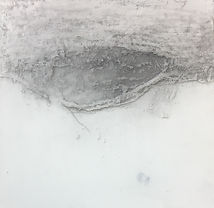
Sinew. Bandage, newsprint, PVA and graphite on canvas board
20 x 20 cm
7 December 2019

Support 7-I. Plaster bandage, and pigment on board
20 x 20 cm
7 December 2019
Support 7-III. Plaster bandage, and graphite powder on board
20 x 20 cm
7 December 2019

Self-Portrait with Eye Removed
Oil on gesso prepared paper
68 x 56 cm
5 December 2019
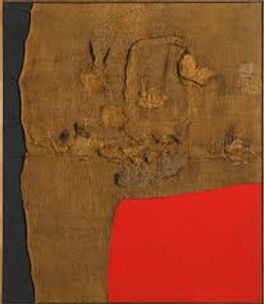
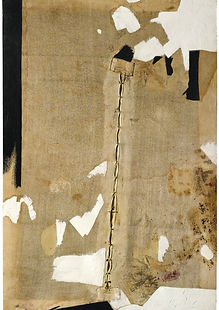
Alberto Burri Lo strappo (The Rip)1952 Oil
fabric, thread, pumice and Vinavil
87 x 58 cm
Collezione Beatrice Monti della Corte
I have started making supports with bandages, plaster, PVA, paper and gesso, this marks a real change in the direction of my work and thinking. Preparing my work for presentation at the Group Crit this week consolidated my research and making and begun to answer some fundamental questions about how trauma can be expressed in non-figurative work.
This change in direction has been prompted by a number of things, the work of Kenyan Swedish artist Catherine Anyango Grünwald, reflecting transformation of Syrian Boy to Wiped Out (Syrian Boy), the discussion of my work in the Group Crit and my research into the work of Lee Krasner and Alberto Burri.
Viewing the work of Catherine Anyango Grünwald a Kenyan Swedish artist’s animations ‘The Slow Death of a Woman in Aleppo’ and ‘Live, Moments Ago (the death of Mike Brown)’ link. Viewing these works and being impressed by the depth of emotion they convey I understood how the erasure and the destruction of the surface of the support (paper in both these examples) is essential to the narrative concept.
Using the mark-making techniques I have been experimenting with to transform my painting Syrian Boy to Wiped Out (Syrian Boy) I realised that the removal of the painted surface had begun to take on a significance to the subject. As well as painting over the image to transform it I was also rubbing away the painted surface with sandpaper and steel wool to leave a trace of what was below. This idea of working the support to the point of destruction, really took hold during Jo Love’s lecture this week. Remembering the physicality and tactile nature of the paper, in her show at Standpoint Gallery early in the term I tentatively made a physical hole in one of my self-portraits.
At the Group Crit with Mark Fairnington the potential of making the treatment of the support integral to the narrative of my work was consolidated by discussions we had around Self-Portrait with Eye Removed, the re-worked ‘Syrian Boy’ and the roughly made ‘calendar works’. This led on to the work of Alberto Burri, which I later looked up in detail.
In parallel to these experiments with my work I have been reading the catalogue ‘Lee Krasner: Living Colour’ and thinking about gesture and how it contributes to the expression of trauma in her work. I have been looking at two specific periods of her work; the collages made in 1955 and the Umber series made around 1960. Desert Moon 1955 is made from torn up rejected works. Large paintings, such as Polar Stampede 1960 was made during a period of acute insomnia following the deaths of Pollock and relatively soon afterwards, her mother. Both carry the narrative of trauma in the way the surfaces are worked, though in very different ways, the collages because the destruction of the initial works is visible in the collages but in the large studio paintings it is the physicality of the mark-making, the evidence of the energy required left in the painted surface that contributes to the narrative.
With these ideas in mind I have begun to experiment with plaster, bandage and PVA, making supports that express ideas of trauma. I have researched Alberto Burri’s ‘Sacchi’ series. These can be considered self-portraits in their expression of Burri’s Second World War experience as well as – according to Emily Braun, curator Guggenheim’s retrospective of Burri’s work in 2015 – ‘an artist’s understandable attack on fine-art tradition’1 following the catastrophe of totalitarianism and genocide’. Interestingly Burri’s ‘Sacchi’ works were exhibited at the Stable Gallery in New York just a few years before Lee Krasner’s collages were displayed there.
Making these new works feels like a very exciting change, at last it feels like my experiments with mark-making maybe leading towards a way of resolving my two key dilemmas of this term:
-
Am I depicting or expressing trauma?
-
Should my expression of trauma be figurative or abstract?
I have moved away from the figurative self-portrait and into a new area of research through making – reflection in action (Jonathan Kearney Methods and Methodologies lecture16 October 2019). I now understand that not only gesture is integral to the expression of a specific idea, such as trauma but also that the treatment of the support itself might be useful to me in the expression.
1 Alberto Burri: The Trauma of Painting, Solomon Guggenheim 2015
29 November 2019 Materiality of Paint
__________________________________________________________________________________________________________________________
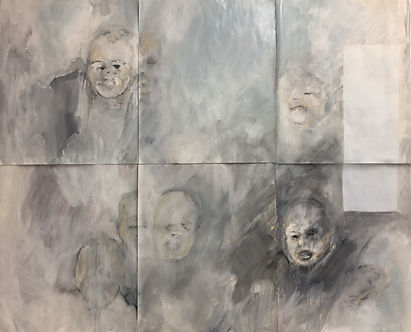
Wiped Out (Syrian Boy). Oil paint applied with rags, steel wool and newspaper on gesso prepared paper
136 x 168 cm
25 November 2019

Six new Selfie Self-Portraits
Oil paint applied with rags, steel
wool and newspaper on gesso prepared paper
136 x 168 cm
28 November 2019
Still very much conflicted by the work I am doing. The week started well when – to my surprise – I continued to work on the Re-worked Syrian Boys painting. Working in the Seminar Room with lots of space I reassembled the six panels as one composition. Determined to eliminate some of the imagery, I used my new, paint and rags, technique to push back all of the faces and just concentrate on two faces – the ones I had re-worked when they were separate. I allowed two other groups of shadowy faces almost erased. Working in other areas and across the joints in the ‘tiles’ with colour and gesture only, the composition began to emerge. Finally, having blanked out one area on the right I decided to leave this as empty, a lighter colour more simply worked, a window on to something else. The type of gesture and the materiality of the paint have become really important to me as well as reducing the amount of recognisable imagery. But without the original very clear figurative work below it feels like this would not have been possible, so this leads me to question myself about the act of erasure too and how important this is.
Deep down I am still not convinced that the work has to be figurative at all and I think if I can I need to eliminate the figure/faces entirely though I cannot imagine what ‘this’ would then be. Perhaps it is an exploration of what corporeal is rather than me, this gets back to the question of what is self. Reading about Lee Krasner and how she worked is beginning to raise other interesting questions about getting to grips with the emotive possibilities of a limited palette and specific types of mark-making. The other self-portraits series I started this week are not at all successful and I am not sure where they are going.
I enjoyed lithography this week and think it would be useful to explore the mark making possibilities of this more as well as the transparency of the inks.

Child's Head, Litho print
26 November 2019
23 November 2019 Expression of trauma, the corporeal and self
__________________________________________________________________________________________________________________________

Close up of eye, see self portrait right
23 November 2019

Self portrait oil paint dipped rag and some brush work on black gesso
23 November 2019

Quite a hard week in the studio. I have been doing lots of reading and have been unhelpfully obsessed with what is meant by ‘the self’ and representations of the corporeal and the possible impact of these on the work I am doing. I am continuing to paint faces using but making marks with rags and newspaper. This is interesting and the resulting images more successfully represent of the type of emotions I want to convey but the faces still don’t feel like the right vehicle to express the psychology of trauma.
I have read Freud’s ‘Remembering, repeating and working through’ and am continuing to read Encounters in the Virtual Feminist Museum. I find Griselda Pollock’s discussion of Aby Warburg’s Mnemosyne Atlas archive very interesting. I am excited by the idea that radical shifts in the way images or art is interpreted can be affected, by setting up encounters that remove them from the phallocentric and nationalistic art historical tradition. However, I am still considering how this could impact my work. Antony Gormley’s images lightly staining human forms on to paper, in sketches or piles of clay are still in my mind.
Made two stretchers in the wood workshop from timber through to stretching canvas and priming.
Eye in large calendar grid
23 November 2019
14 November 2019 1:1 Critical Practice tutorial Anna Bunting-Branch
__________________________________________________________________________________________________________________________
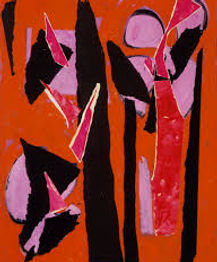
Lee Krasner Desert Moon 1955
Collage of oil on paper on canvas.
Living Colour, Barbican 2019
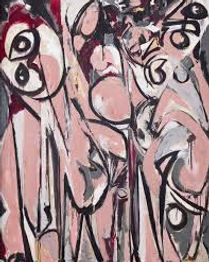
Lee Krasner Three in Two 1956
Oil on canvas
Living Colour, Barbican 2019
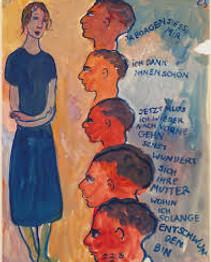
Charlotte Salomon The game of life
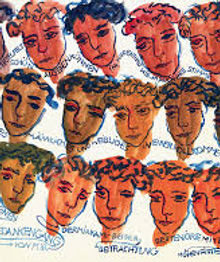
Charlotte Salomon
Very useful conversation with Anna on how to narrow down and focus my project proposal, The emotive self-portrait.Leading on from the conversation I had with Geraint a few weeks ago and the work I am now doing in the studio around gesture, the corporeal and the expression or depiction of trauma. There are a few lines of enquiry now identified to enable me to direct my research i) to define what we mean by ‘the self’ and reach an understanding of some of the basic methods of psychology ii) to use a specific artist to reflect on Abstract Expressionism and what contemporary critics are saying about their work now, and iii) to use my research and the theories I have gain an understanding of through my research to analysis the work of other artists.
Specifically, I intend to read an article by Sigmund Freud ‘Remembering, repeating and working-through’ to further my knowledge of psychological methods. This is particularly interesting in relation to art practice, identity, self and muscle memory.
I intend to research the Lee Krasner ‘Living Colour’ exhibition at the Barbican earlier in the year. To explore the potential of using Lee Krasner as a female Abstract Expressionist, to look at the narrative of trauma and to use what I discover to analysis the work of others. In relation to this I will also read ‘Wet: on painting, feminism, and art culture’ Mira Schor to explore body expression and the materiality of painting.
I have begun to read Griselda Pollock ‘Encounters in the Virtual Feminist Museum’ and will also read her book ‘After Affects’ about trauma. Ideas of series and archiving are still present in my work and I am continuing to explore these in my practice as well as through the work of artists such as Amy Sillman, Susan Hiller and Charlotte Salomon.
11 November 2019 Exploring trauma, gesture and the nature of self
__________________________________________________________________________________________________________________________
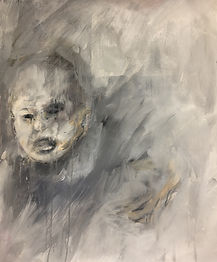
Syrian boy reworked using scrunched newspaper and brush
11 November 2019, bottom right tile

Self portrait, oil paint dipped rag on black gesso, 11 November 2019

Syrian boy reworked using scrunched newspaper and brush
11 November 2019, bottom left tile

Self portrait, oil dipped rag, scrunched newspaper and minimal brush work on white gesso,15 November 2019

Rag painting on glossy photographic print
12 November 2019
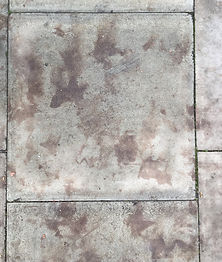
Leaf stains, Peckham paving
14 November 2019
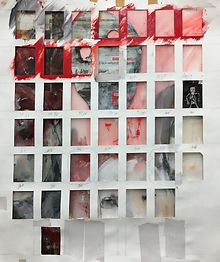
Calendar grid overlaid
7 November 2019

Eleven red days, calendar grid
15 November 2019
Continuing to explore ideas about the relationship between the gesture and subject matter I have been experimenting with different mark marking techniques and the way these can influence the expression of ideas. Returning to the image of the Syrian boys I isolated a single boy on two separate tiles of the painting and worked over these using scrunched up newspaper. The marks I am making have become more expressive, and smeary. The wet paint moves across the dryer smooth surface of the underpainting, making the urgent sweeping marks made with the newspaper and oil paint easier to achieve.
Using the same technique, I experimented working on glossy photographic print outs of selfie images. They are quite small but the feel of the paint on the glossy surface was similar to the underpainting of the Syrian boys’ image, though the way the photographic paper absorbs the oil paint is very different, it dries quickly meaning a different type of mark can be achieved. I also rubbed back with sandpaper which again can be done quite quickly as the paint dries very fast on the photo paper. Following this I made several new self-portraits painting with rags dipped in oil paint on black and white gesso ground. The resulting mark making is very expressive and is most successful when the direction of the smears is carefully considered, for instance in Face on white gesso 15-11-2019. The fewer marks there are making up a recognisable face the better the results seem to be as too much figuration looks very contrived and looses its impact, particularly when on black gesso. This is very interesting in relation to the Käthe Kollwitz exhibition I saw this week link where some of the most successful works such as Woman with dead child, leave a lot of the face to the viewer’s imagination making the image of grief even more powerful.
What type of ground I am working on is becoming more and more important in order to achieve the types of marks I want in the image and the expression of some marks in the under painting? This week I have worked with Tim Johnson to prepare a variety of canvases with grounds I have not used before, clear rabbit skin glue, red distemper and clear acrylic gesso with Lascaux white gesso on top. I intend to use these to paint the same image but using a variety of mark-making techniques such as I have been using this week.
I am still finding the imagery/source material I am using unsatisfactory and intend to explore this further by carrying out some of the desk-based research I discussed with Anna Bunting-Branch this week. There are two main lines to this enquiry what is ‘the self’ I want to express, is it a concept or something figurative and where and how does this meet any narrative that is part of the work? The idea of time passing, erased marks and the calendar are still something I am working with in my ‘Calendar grids’ how or if the concept of self and expression of trauma come together with this, I am still not sure. The leaf impressions on the pavement in Peckham that I photographed this week seem to give a clue to this, as well as some further ideas about underpainting, rubbing away and erasure and what this could express about time. I intend to move the calendar grids into three dimensions too.
Finally, the Antony Gormley exhibition at the Royal Academy had a much greater impact on me than I had anticipated. His ability to express something universal about the human condition not through the very well-known standing bronze figures but through the much smaller sketches and drawings on paper I found particularly interesting. The simplicity of the marks and the way the insignificance of being a single human in the world or the universe is evoked through things which appear relatively in consequential made me consider my own source material again. The smears of what seemed like bodily fluids, though they were not, on fabric or paper were very evocative. Often so faint they suggested the passage of time suggesting shrouds or ancient cave paintings. These made me think again about things that express the visceral without resorting to clichés of blood colours, such as what a mark is made with and being made aware of the smear being made by the touch of a hand or body part. He also used what in effect was distemper (pigment in rabbit skin glue) ion paper which I have already started experimenting with.
8 November 2019 Trauma, the feminist self-portrait and the corporeal body
__________________________________________________________________________________________________________________________

Syrian Boys painting, development and preparation for screen print
5 November 2019

Skull painting, exploring how to paint
trauma / representations of the corporeal
5 November 2019
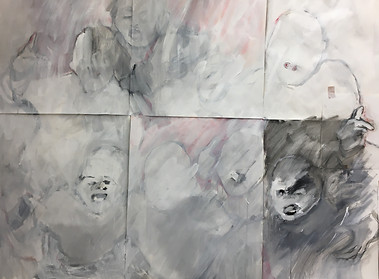
Syrian Boys painting, reworking
7 November 2019

The Syrian boy painting I am working on has raised quite a number of issues which were the starting point of a discussion with Geraint in the Studio this week. The painting using the repeated image of a Syrian boy being pulled from the rubble of a bombed building. Repeating the image has unintentionally changed it from an image of trauma, to one of gangland defiance. This raised questions about the source material I am using and the way I am painting and how the two connect, is it what I am painting that is important or how I am painting it? I spoke about how different I found it working with an image I have a personal connection compared with working with a found image. The discussion expanded to the power of repeated images such as August Sander’s work and how the corporeal has been expressed in non-figurative work. We touched on artists who have used their own bodies in very different ways comparing the rawness of Jo Spence’s work as seen in ‘Misbehaving Bodies’ at the Wellcome Collection last week link, with more lyrical depictions of self, such as Helen Chadwick’s ‘Viral Landscapes’ 2006. This series of photographs combine panoramic landscapes of Pembrokeshire with ‘sea paintings’ carried out on this shoreline and images of the artist’s cellular tissue removed from her mouth, ear, blood, cervix and kidneys. They are a complex metaphor for change and evolution, the individual and nature, the virus and its host prompted by the heightened AIDS awareness of the 1980s.
In Women’s Self Portraits Frances Borzello’s cites artists such as Helen Chadwick and Jo Spence as being part of an enormous number of contemporary female artists who have challenged the very definition of self-portraiture. She describes how feminist approaches to the use of their own bodies in their work created a radical shift so that women artists were no longer just depicting themselves but were using images of themselves or their bodies to comment on the position of women in society or the world.
Thinking about these women’s work together with Michele Crossley’s article Narrative psychology, trauma and the study of self/identity link has led to a significant shift in my practice. The article describes the psychological tools we use to navigate and make sense of our lives. It discusses the importance of ‘storytelling’ or creating a personal, unspoken but psychological narrative for ourselves. Paramount to this is being able to place ourselves in time and be able to use our past story (family history, relationships, cultural understanding and ideas of acceptable behaviour) to navigate our present experiences and project forward into the future. However, trauma such as the diagnosis of a life-threatening illness, disrupts the most basic existential assumptions people hold about themselves and the world. We are shocked out of complacency and the assumed futurity of our existence and have to go through something termed ‘narrative reconfiguring’ in order to deal with trauma. ‘people cope with the disruptive effects of pain, illness and traumatising events through storytelling narrative reconfiguring such stories are a vehicle for making sense of not just illness but life itself.’ M L Crossley 2000
The ideas in Michele Crossley’s article and looking at women’s work around the self-portrait and its redefinition as described in Frances Borzello’s book has led me to a different understanding of my work and what is important to it. Consequently, I have begun to explore my subject matter/trauma in a different way and to look at ways of conveying emotion or the corporeal body rather than depicting them. This has given me permission to move away from figurative work and experiment with abstraction without thinking this is necessarily binary.
What next?
My intention is to produce 20 or 30 pieces of work, which will explore ideas of time passing, trauma, the corporeal body. They will be test how different types of mark making can affect the subject matter and how ideas of the body can be evoked through what medium is being used and how it is applied. In parallel I intend to examine how ideas of time can be conveyed using calendars, erasure and the corrupted painted surface.
Exploring trauma, the passage of time, representations of the corporeal
7 November 2019

Syrian Boys painting,
reworking bottom right panel
7 November 2019
30 October 2019, Reflections on painting in the studio
__________________________________________________________________________________________________________________________


Sketchbook image collaged drawings of Syrian boy image
Sketcbook image with newspaper clipping Syrian boy
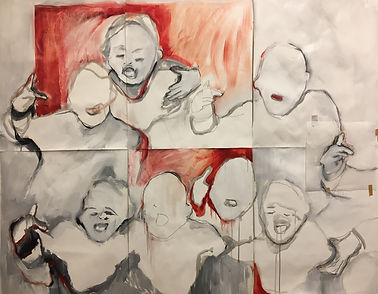
The new painting I started this week uses a drawing I made from found image of child being pulled from a destroyed building (in Syria?) as my starting point. I had the image in my sketchbook for a while and had used to make some sketches and collages. My aim was to use this work to interrogate the way I work and understand what of this are habits and what are essential to my practice and why. I restricted my experimentation to three things, a change in subject matter, taking my mark making across the boundaries of the ‘tiles’ and restricting my colour palette, all things discussed in my tutorial with Anna.
I am enjoying working with this image. The introduction of the hands as well as faces alter the meaning of the image suggestion both defiance and helplessness in the child and nurturing in the adult hands which appear without being attached to an adult body. I restricted my palette to black, white and red only as this is what I had used it in the sketches.
The red colour suggests trauma, war zone but also because of the defiant hands something of children involved in gangs which surprised me. I have found working with a very limited palette helpful. It stops the work becoming sentimental and me falling back on easy habitual, pastels and flesh tones.
What next?
I will test the idea of the individual tiles further by perhaps painting one more painting of the same subject and then photographing both in C131 but also by assembling them, so the tiles are disjointed. Depending on the results of this I may try then painting over them leaving them deliberately disjointed. I am going to try using a deep turquoise blue instead of the red in the next painting to see how that alters the feel of the subject. I have taken my marks across the boundaries of the ‘tiles’ though I am working in series in that I’m using repeated imagery. I am going to go on interrogating this, using repeated screen printed images behind the paintings.
Syrian Boys painting on six sheets of gesso prepared paper
30 October 2019


Syrian Boys painting development, two close ups
31 October 2019
22 October 2019 1:1 tutorial with Anna Bunting-Branch
__________________________________________________________________________________________________________________________

Selfie Self Portraits / Group of 12
17 October 2019
Selfie Self Portraits / development
19 October 2019

Sketcbook image with newspaper clipping Syrian boy
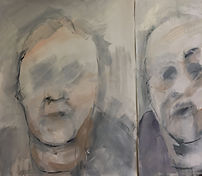
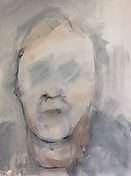
Anna helped tighten my resolve to challenge myself to undertake a more radical exploration the subject matter I am using. Or discussion also raised some useful questions habitual practice. In order to challenge this and discover how interested I am in the mark marking over the subject matter I am going to set myself experiment with materials, set myself some working parameters such as working with a wider range of tones and to work with different subject matter, perhaps found images.
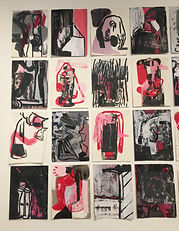
We discussed working in series, and I referenced Amy Sillman and Kitaj’s Erasmus Variations both of which I had been thinking about in relation to my work. This led to a conversation about archival practices, making me conscious of the connection with my professional life in museums. I have decided to explore this and investigate whether or not it is something integral to my practice.

Amy Sillman Camden Arts 2018

Erasmus Variations
Kitaj
18 October 2019 at Camberwell
__________________________________________________________________________________________________________________________
Selfie Self Portraits
18 October 2019


Intra Venus 1993
Hannah Wilke
Crisis Project / Picture of Health? (Property of Jo Spence) 1982
Jo Spence
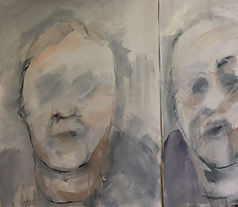
Since starting the MA course at Camberwell, I have continued working with the theme of conveying interiority through multiple portraits. This is a project I have been developing since last year.
I made some immediate changes to the way I am working, the main one being to work larger and return to more gestural mark making.
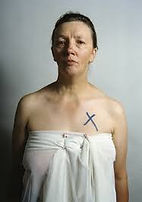
Reflecting on the project while making it the work a number of questions have arisen such as what is the true nature of my subject matter and are the images I am currently working with too familiar now? Am I really interested mortality, in conveying trauma and transitional states or is it portraits or possibly self-portraits I am really interested in? It would feel very exposing to work with the self-portrait and would make me feel very vulnerable but perhaps this is exactly why I should do it. In relation to this I have been thinking of the work of Jo Spence and Hannah Wilke.
At the moment I have made the title of my Project Proposal ‘The emotive self-portrait: an investigation into how we navigate the world and represent ourselves at times of trauma or transition’. I intend to explore this through reading and continuing make new work during the next few months. I feel it is important to allow myself sometime for experimentation and exploration and despite the pressure of time to try and resist feeling that I need to settle on the work I want to produce straight away.
