13 November 2019 Käthe Kollwitz Portrait of the artist British Museum
__________________________________________________________________________________________________________________________
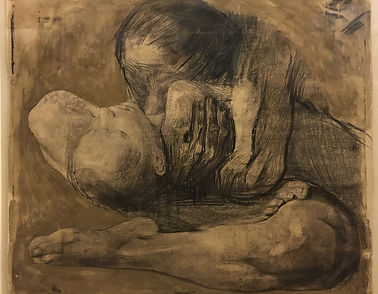
Woman with dead child,1903
Etching, drypoint, sandpaper, imprint of Bütten and Ziegler's transfer paper, overworked with gold-coloured wash graphite and charcoal, third state

Self portrait 1924
Woodcut, sixth state
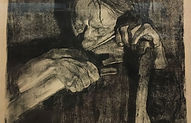
Sharpening the scythe (Beim Dengein) before mid-May 1908. Etching drypoint, sandpaper and Ziegler's transfer paper, eight state

The exhibition of drawings and prints was very traditionally displayed with simple explanations and contextual information. The prints use a mixture of print techniques, woodcuts, lithographs and etching often mixed together with dry point and aquatint.
Käthe Kollwitz was deeply affected by the poverty and suffering she saw around her which were the result of the unstable political situation in Germany and the first and second World Wars. She lost both her sons in the wars, she was a committed pacifist and She used images of herself and others to convey grief, often concentrating on facial expressions but also using hand gestures and the whole body to depict suffering. Karl Scheffler in ‘Hands’ an essay from 1912 ‘In addition to their property as tools, they have something like their own soul ... in them can be seen the whole man.’
Her emphasis is on the experience of mothers and widows of the young men whose lives had been sacrificed. She lost both her sons in the wars and saw certain series of her prints as propaganda for the pacifist cause. Determined that her ‘War’ 1922 and 1923, a series of woodcuts be published and in circulation not only to collectors but also more widely available at the lowest possible price, she had them printed in what she described as a ‘people’s edition’.
Currently grappling with using self-portraiture to express trauma in my own practice I found Käthe Kollwitz’s work very thought provoking. She successfully manages to convey acute suffering through using images of herself and others. The fact that her images have become iconic images of grief and mourning bears testament to her success. She manages to convey such depth of emotion through her expressive drawing, her chosen printing techniques and the way she treats the physical surface of the prints. Her skill as a draughtswoman is paramount, in ‘Woman with dead child’ it is not only the Rodin-like plasticity of the drawing in the whole grasping body of the woman that expresses what she cannot bear to be true, but also the way that areas of high definition are contrasted with sketched features. The squashed but ill-defined nose, the eyes suggested by dark smudges give the viewer just enough to imagine the rest; to be drawn into the emotion the woman feels and then imagine what is not shown, the pressure of the woman’s body against her dead son, the weight in her arms. These images of anguish and misery are heightened by the harsh lines of the woodcut or the roughly drawn lines scratched into the etching plate. Kollwitz exaggerates these features of her work by further disrupting the surface such as rubbing it with sandpaper and so the mark or gesture becomes as important as the subject, in giving grief and trauma expression.