The ‘personal is political’:
in what way do current understandings of trauma influence our
critical approach to expressions of trauma in contemporary art?
MA Fine Art Painting: Critical Practice Essay
May 2020
___________________________________________________________________________________________________________________________________________________________________

Alina Szapocznikow with Invasion of the Tumours outside
her studio at Malakoff (Stanisławski, 1970)

Alina Szapocznikow Sans Titre/Without title
(Love 1970) (Ingham, 2020)

Visitors to Fragmentos by Doris Salcedo in Bogotá, Colombia
(Mazars, 2019)

Doris Salcedo Disremembered II and III (2014)
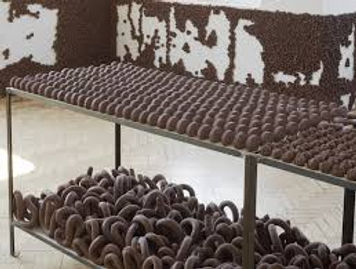
Installation view, Anna Maria Maiolino Continuum at
Camden Arts Centre (Keate, 2010)

In-Out Antropofagia (1973) In-Out Anthropophagy
(2018)
Abstract
This essay is an investigation into how contemporary understandings of trauma influence artists and their (critical) interpretations. It analyses, using specific examples, the ways in which artists Alina Szapocznikow, Doris Salcedo and Anna Maria Maiolino engage with narratives of trauma in their practice. Of major importance to all three artists is materiality, together with the body and ideas of the absent body. The ways in which they manipulate materials to articulate these themes is analysed together with the processes involved in creating their work. Each artist has had personal experience of trauma and by examining the socio-political context of their work, this inquiry draws out how personal experience becomes, for some, a political imperative. This is discussed using biographical detail and with reference to current philosophy, ideas of psychoanalysis and trauma studies. Compelled by the current growing and urgent interest shown by academics, politicians and the media in understanding trauma and its effects, I am cognizant of the importance of contemporary context to all art, both its practice and its understanding. Driven by personal experience of acute trauma, my research resonates with my studio practice and has led to a renewed sensibility and deeper understanding of the expression of trauma in artists’ work. The implications of my research have been far reaching for my personal practice and has raised an important question, what is art for?
Key Words
___________________________________________________________________
expressions of trauma | phenomenology
Alina Szapocznikow | Doris Salcedo | Maria Maiolino
________________________________________________
Everyone who is born holds dual citizenship, in the kingdom of the well and in the kingdom of the sick. Although we all prefer to use the good passport, sooner or later each of us is obliged, at least for a spell, to identify ourselves as citizens of that other place.
(Sontag,1978 p.3)
This essay will investigate how the experiences of trauma in the lives of Alina Szapocznikow, Doris Salcedo and Anna Maria Maiolino have influenced their practice. Their expression of personal and societal trauma both conscious and unconscious will be investigated through specific examples of their work. These will be examined, specifically through the ideas of Griselda Pollock, feminist art historian and writer on trauma and aesthetics, and American philosopher, Judith Butler. By means of these writings each artist’s expression of trauma will be made clear, through the importance of materiality, the body and ideas of the absent body. In the current period, post-Freud and the birth of psychoanalysis, there is a general understanding of the effects of traumatic events and traumatic experiences on the mind. Now with the establishment of the discipline of trauma studies in the 1980s, together with diminishing taboos around the discussion of mental illness and societal recognition of conditions such Post-Traumatic Stress Disorder (PTSD), there is growing understanding that trauma permanently changes us and that traumatic events can and do re-surface with devastating consequences if not addressed.
In any encounter with the work of Alina Szapocznikow the expression of deep personal trauma can be detected in her dissolving bodily forms made of resin with embedded collage. Born in Poland in 1926 she ‘survived’ the German invasion of Poland but being Jewish was deported to the Nazi concentration camp Bergen-Belsen following years of incarceration in the ghettos. In 1951 she suffered peritoneal tuberculosis only surviving due to treatment with the then experimental antibiotic, Streptomycin. In 1968 she was diagnosed with breast cancer which eventually led to her death aged forty-six.
Trained as a sculptor in the post war period she was influenced by Nouveau Réalisme which she encountered on moving to Paris in 1963. Following this her upright figures carved of marble and stone eventually gave way to experiments with industrial materials, collage and assemblage that subsequently led to works such as Invasion of the Tumours, 1970.
In her lifetime Szapocznikow did not refer to the significance of her past or the range of associations engendered by her work. In a recent re-appraisal of her career Griselda Pollock describes what she sees as the gradual emergence of ‘encrypted trauma’ (Pollock 2013, p.185).
‘the traces of the encryption of trauma (some of it known but unbearable, some unassimilably horrific) nonetheless leaked from its psychic entombment and surfaced over the twenty-eight of her practice as a sculptor’ (Pollock, 2013 p.191)
Writing about Szapocznikow’s work, Pollock (2013) describes the complexities of being a Holocaust survivor during the post war period. A time when there was no understanding of what it meant to ‘survive’ nor understanding of the need for survivors to ‘bear witness’ in the presence of an ‘empathetic listener’. What Pollock sees is the ultimately irrepressible psychological damage caused by Szapocznikow’s encounter with one of the most traumatic and catastrophic events of the twentieth century.
For Szapocznikow it was her work that became the essential ‘empathetic listener’. The embodiment of the trauma of being a survivor and her later battles with illness are manifest even in such small works such as Sans Titre (Love 1970). Here distress is registered in the separation of the breast from a body and the gauze hospital bandages embedded in the uneven resin surface ‘skin’. There is a poignancy in the small scale (equivalent to the palm of a hand) of the work and the suggestion of living flesh in its translucent delicate colour.
During the period in which Szapocznikow was working the full horrors of the Holocaust were only just beginning to be understood. There was no sustained research into the psychological effects of political violence, torture and war and no effective psychological methods developed for treating survivors. Corby (2002) describes the effects of unresolved trauma and loss as having the power to
'inhabit a life as a traumatic ‘present-day force’ [able]… to modify contemporary experience and … be modified by the revival and revision of deferred action.' (Corby, 2002 p.161)
Fully cognizant of our current understanding of trauma and its effects, artist Doris Salcedo engages with trauma to realise an ambitious intent: to offer resolution for victims through her installations.
Born in 1958 Doris Salcedo lives and works in Bogotá, Colombia, where for fifty-two years there raged a violent civil war. Highly political, Salcedo‘s practice examines ideas of traumatic loss and has historically addressed the political violence of her native country and its legacy.
'Her [Salcedo’s] art practice forges intimate connections between the individual experience of loss and the depersonalising act of terror by giving a material object-form to traumatic memory within the bounded lieu the installation space.' (Wong, 2007 p.180)
Her career-long intent to provide victims of violence with sites of mourning and commemoration is widely acknowledged by academics, critics and commentators inside and outside the artworld. In 2016, a peace agreement was signed between the government and the Revolutionary Armed Forces of Colombia, known as the FARC, and Salcedo became involved in the country’s attempt to reconcile the population to the atrocities of the past. She created Fragmentos, 2018 from 37 tons of rifles turned in by 13,000 rebels as part of the peace agreement. She had the guns melted down in a foundry and employed women who had suffered physical and sexual abuse during the conflict to help shape the steel into 1,296 tiles installed on the floor of a new monument and gallery.
Salcedo demonstrates an understanding of the psychology of trauma in the modern age and is clear about her intent,
‘I have produced all of my work driven by the obsessive need to render visual the experience of the most vulnerable anonymous victims of political violence’ (Salcedo, 2016)
She ‘calls out’ societal trauma and sees art as being able to pose the questions that do this. The American philosopher Judith Butler sees Salcedo’s work as performing a unique function able to link Human Rights, forensics and art, to make unknown deaths matter and to establish the value of lives lost even when the facts of the deaths and the number who have died are impossible to establish. She describes Salcedo’s works as,
‘A double act of memorialisation and testimony, an act of mourning that does not supress or deny the violence that has taken place but installs that violence at the centre of the scene’ (Butler, 2017)
She sees Salcedo’s work as offering the place and opportunity for victims of violent crime, and their families, to grieve.
The paradox as Butler (2017) describes it, is that to do this Salcedo has to materialise the lives lost in some form,
‘Every act of making visible is haunted by what can
no longer appear.’ (Butler, 2017)
This she has done in countless different ways making us aware of the absent body using materials that are already charged with significance and suffused with meaning accumulated over years of use in everyday life. These delicately and laboriously produced objects are haunted by absence and the process of making itself becomes included in the act of mourning and commemoration. Specific historical events are often Salcedo’s point of departure followed by research listening to the testimonies of victims and their families before developing her works. The sculptures Disremembered I, II and III are made of over 12,000 steel needles woven into raw silk and mounted in the gallery as if they have the body of the wearer still within them. When viewed from different angles, the sculptures oscillate between visible and invisible; the glint of the metal and the sheen of the silk appear and disappear simultaneously like a fading memory.
Straddling the conscious confrontation of trauma in Salcedo’s practice and unconscious emergence of trauma in the work of Szapocznikow, is artist Anna Maria Maiolino. Her practice merges the personal and political, chronicling the ordeal of poverty and the trauma of being ‘other’, as well as denouncing the societal trauma of living under military dictatorship, subject to the threat of violence and censorship.
Born in the south of Italy in 1942 and the youngest surviving child of ten, Maiolino migrated to Venezuela with her family and then to Brazil. Over the course of her career she has worked in a variety of materials including the written word. Living under the oppressive regime in Brazil, she worked with new trends in the Brazilian avant-garde. Her practice is rooted in the Brazilian Neo-concrete movement and Minimalism, it is also linked to Italian Arte Provera, with its aesthetic purity, economy of materials and political underpinning. Since the 1980s she has worked in malleable materials such as clay, cement and plaster. Like Salcedo the labour-intensive processes used to create her work are integral to her themes but instead of being acts of commemoration and mourning they connect her work to the repeated gestures and tasks of everyday survival.
This imprint of unconscious daily rituals can be seen in the hand modelling, moulding and casting of each individual piece that made up her site specific installation Continuum, 2010 at Camden Arts Centre. Here the galleries were filled with hundreds of pieces of clay: fixed to the walls, stacked on industrial metal benches and on palettes on the floor. Represented in her mark-making are ideas of the laborious processing of raw materials linked with bodily functions such as eating and defecating. In this work and throughout her practice she takes on complex issues of ethnicity, social justice, and gender through a variety of media.
‘[she] binds past present labour and art, care and creation.’
(Pollock 2013, p.145)
In the film In-Out ,1973 she films close up mouths attempting to communicate while being obstructed by various objects. For Maiolino the act of enunciation and physical expression is a liberating force.
‘Imagery of violently imposed silence, patience for avengement, and quiet acts of resistance abound in her practice, using both her own and others’ bodies as her touchstones.’
(Dambrot, 2018)
Maiolino’s work like Szapocznikow’s resounds with her personal trauma but in Maiolino this is enmeshed with the trauma of repression and violence in Brazil. Her intent, like Salcedo’s, is to ‘call out’ and make visible societal trauma but instead of offering resolution Maiolino’s is a quieter commentary.
At the start of this research my intention was to investigate the differences between expressions of personal and societal trauma in contemporary art but what I discovered is something much more nuanced. I realised that one artist’s work can be an expression of both and that these expressions are as much the result of the socio-political context in which the artist was working, as is our interpretation. For Szapocznikow there was no ‘empathetic listener’ and no understanding of the need for one: there was no deliberate intent or public purpose in her profound expression of trauma, but her art did provide a place to ‘work through’ her unrecognised trauma. Working in the current era and equipped with current knowledge of trauma and its effects, Salcedo and Maiolino consciously engage with their experiences of societal trauma: the civil war in Colombia and living under dictatorship in Brazil. They both take this on choosing to express it in their work as a political act. Though their methods for doing so are very different, for them both there is purpose in art when used to focus attention on society’s ills and provide a space for reflection. Maiolino consciously mixes this with expression of her personal trauma of being other, deprived of language, and unable to speak out; the result is work with a subtle multi-layered expression of trauma. Important to each artist is the manipulation of materials to create haunting and powerful signifiers of trauma linked with loss, repression and pain. A deeper engagement with their work has developed my phenomenological awareness: an understanding of the power of materials and their ability to communicate thoughts feelings directly. Through this investigation, my research and studio practice have become entwined. This has had a dynamic effect on my work and made me conscious of the impact of each of my decisions on the potential meaning of my work. Most importantly this investigation has demonstrated the importance of the socio-political context to all understandings of contemporary art.
Post script: My essay links to exhibitions link I have visited and research link I have been engaged with throughout Unit 2, here are links to a couple of examples.
References
_____________________________________________________________________
Butler, J. (2017) Shadows of the Absent Body
Topography of Loss: A Symposium on Doris Salcedo.
Harvard Art Museums, Cambridge, Massachusetts, 2 March 2017
Available at: https://www.youtube.com/watch?v=9o9_ZP2Z7aI (Accessed 6 April 2020)
Corby, V. (2010) Eva Hesse Longing Belonging and Displacement New York.
I B Tauris & Company Limited
Dambrot, S N. (2018) Anna Maria Maiolino at MOCA Art and Cake 11 January 2018
Available at: https://artandcakela.com/2018/01/11/pacific-standard-time-la-la-anna-maria-maiolino-at-moca/ (Accessed 3 May 2020)
Pollock, G. (2013) After-affects - After-images: Trauma and aesthetic transformation in the virtual feminist museum, Manchester UK: Manchester University Press
Salcedo, D. (2016) Art Talk: Doris Salcedo. Pérez Art Museum Miami, 23 April 2016
Available at: https://www.youtube.com/watch?v=kzDwz0QLRvA
(Accessed 10 April 2020)
Sontag, S. (2002) Illness as Metaphor and Aids and its Metaphors London: Penguin
Wong, E L. (2007) ‘Haunting Absences: Witnessing Loss in Doris Salcedo’s Atrabilarios and Beyond’ in Guerin, F., Hallas, R. (eds.) The Image as Witness. London. Wallflower Press, pp.173 – 188.
Images
_____________________________________________________________________
Disremembered II and III (2019)
Available at: https://imma.ie/whats-on/doris-salcedo-acts-of-mourning-exhibition/
(Accessed 6 May 2020)
Ingham, C (2020) Alina Szapocznikow Sans Titre/Without title (Love 1970)
Keate, A. (2010) Installation view, Anna Maria Maiolino Continuum at
Camden Arts Centre. Available at: https://archive.camdenartscentre.org/archive/d/anna-maria-maiolino (Accessed 1-04-2020)
Mazars, N. (2019) Visitors to Fragmentos by Doris Salcedo in Bogotá, Colombia.
Available at: https://www.nytimes.com/2019/10/23/arts/design/colombia-farc-peace-monument.html (Accessed 26 April 2020).
Modern Art Oxford Anna Maria Maiolino: In-Out (2018) In-Out Antropofagia,1973.
Available at: https://www.modernartoxford.org.uk/event/artaction-in-out/
(Accessed 7 May 2020)
Stanisławski, P. (1970) Alina Szapocznikow with Invasion of the
Tumours outside her studio at Malakoff.
Available at: https://artmuseum.pl/en/archiwum/archiwum-aliny-szapocznikow/91/2732
(Accessed: 4 May 2020)
Bibliography
_____________________________________________________________________
Akkermans, A. (2016) A Divided Reception for Doris Salcedo’s Memorial in Bogotá Hyperallergic Available at: https://hyperallergic.com/331486/a-divided-reception-for-doris-salcedos-memorial-in-bogota/
(Accessed 2 May 2020)
Alina Szapocznikow Archive (no date)
Available at: https://artmuseum.pl/en/archiwum/archiwum-aliny-szapocznikow/91/2732 (Accessed: 4 May 2020)
ARTtube (2015) In the Studio of Berlinde de Bryckere, 13 November 2015
Available at: https://www.youtube.com/watch?v=ZotDGJONHJM
(Accessed 21 February 2020)
Ashbury, M. (2019) Anna Maria Maiolino: Articulations and Translations of and in Anthrophagy 190827_AMM_Spreads_-pages-35-39 Available at: https://ualresearchonline.arts.ac.uk/id/eprint/14305/2/Asbury.pdf
(Accessed 4 May 2020)
Ashbury, M. (2020) Her Other Selves Anna Maria Maiolino Flash Art April 2015 Available at: https://flash---art.com/article/her-other-selves/
(Accessed 4 May 2020)
AWARE Archives of Women Artists Research and Exhibitions (2013) Alina Szapocznikow Available at: https://awarewomenartists.com/en/artiste/alina-szapocznikow/ (Accessed 26 April 2020)
Bakara, L. Daniels, J., P. |(2019) Columbian artists wins $1m Prize for work on Political Violence The Guardian 31 October 2019 Available at: https://www.theguardian.com/artanddesign/2019/oct/31/colombian-artist-wins-1m-prize-for-work-on-political-violence (Accessed 26 April 2020)
Blouin Artinfo (2014) Anna Maria Maiolino Roams Between Senses. Hauser and Wirth, New York, 15 June 2014. Available at: https://www.youtube.com/watch?v=6qNNXLj4vf0
(Accessed 3 May 2020)
Borzello, F. (1998, expanded edition 2016) Seeing Ourselves, Women’s Self Portraits, London. Thames and Hudson Limited
Butler, J. (2015) Senses of the Subject New York. Fordham University Press
Butler, J. (2017) Shadows of the Absent Body
Topography of Loss: A Symposium on Doris Salcedo.
Harvard Art Museums, Cambridge, Massachusetts, 2 March 2017
Available at: https://www.youtube.com/watch?v=9o9_ZP2Z7aI
(Accessed 6 April 2020)
Calirman, C. (2014) ‘Epidermic’ and Visceral works Lygia Pape and Anna Maria Maiolino Woman's Art Journal, Vol. 35, No. 2 (FALL/WINTER 2014), pp. 19-27 Published by: Old City Publishing, Inc.
Available at:URL: https://www.jstor.org/stable/24395414
(Accessed 4 May 2020)
Camden Arts Centre (2010) Anna Maria Maiolino Continuous Available at: https://archive.camdenartscentre.org/archive/d/anna-maria-maiolino (Accessed 1-04-2020)
Camden Arts Centre (2001) Doris Salcedo
Available at: https://archive.camdenartscentre.org/archive/d/doris-salcedo
(Accessed 1-04-2020)
Corby, V. (2010) Eva Hesse Longing Belonging and Displacement New York. I B Tauris & Company Limited
Dambrot, S N. (2018) Anna Maria Maiolino at MOCA Art and Cake 11 January 2018 Available at: https://artandcakela.com/2018/01/11/pacific-standard-time-la-la-anna-maria-maiolino-at-moca/ (Accessed 3 May 2020)
Diprose, R., Reynolds, J. (eds.) (2008) Merleau-Ponty Key Concepts UK. MPG Books Group
Dunne, A (2019) Quiet Power of Doris Salcedo’s austere vision. The Irish Times 7 May 2019
Available at: https://www.irishtimes.com/culture/art-and-design/quiet-power-of-doris-salcedo-s-austere-vision-1.3878902
(Accessed 1 April 2020)
Fer, B. (2009) Eva Hesse Studiowork, Edinburgh UK, The Fruitmarket Gallery
Fer, B. (2010) Ana Maria Maiolino Precarious Fields Camden Arts Centre pamphlet Available at: https://ualresearchonline.arts.ac.uk/id/eprint/4161/1/51-maiolino-proof-220310.pdf (Accessed 4 May 2020)
Fiske, C. (2013) Oedipal Complex, three documentaries on Louise Bourgeois Artforum 19 April 2013 Available at: https://www.artforum.com/film/courtney-fiske-on-three-documentaries-on-louise-bourgeois-40433 (Accessed 26 April 2020)
Freud, S. (in translation a modified version of the one published in 1924 vol 12 Standard Edition 1950) Remembering, repeating and working through, Further Recommendations in the Technique of Psychoanalysis II: Recollection, Repetition and Working-Through London (Accessed 27 November 2019)
Getty (2019) Eva Hesse Oh, More Absurdity Recording Artists: Radical Women Available at: https://www.getty.edu/recordingartists/season-1/hesse/
(Accessed 25 April 2020)
Hustvedt, S. (2007) Louise Bourgeois: The Places that Scare You The Guardian 6 October 2007 Available at: https://www.theguardian.com/books/2007/oct/06/art (Accessed 3 May 2020)
Irigaray, L (2004) To paint the invisible. Continental Philosophy Review 37,
389–405 Available at: https://doi.org/10.1007/s11007-005-5755-9
(Accessed 8 March 2020)
Irish Museum of Modern Art (2019) Doris Salcedo introduces Acts of Mourning, 23 May 2019 Available at: https://www.youtube.com/watch?v=JSjHsJHaBoc (Accessed 6 April 2020)
King’s College London Trauma Studies Department of Psychological Medicine Available at: https://www.kcl.ac.uk/ioppn/depts/pm/research/traumastudies (Accessed 26 April 2020)
Malallah, H. (2018) Age of Terror: Hanaa Malallah on how conflict has influenced her work Imperial War Museum, 9 March 2018.
Available at: https://www.youtube.com/watch?v=cKeojXhynGs
(Accessed 20 April 2020)
Malallah, H.(2020) Available at: http://hanaa-malallah.com/projects/biohazardproject.html (Accessed 20 April 2020)
Matrix 252 University of California, Berkeley Art Museum and Pacific Film Archive (BAM/PFA) Anna Maria Maiolino Available at: http://archive.bampfa.berkeley.edu/images/general/press/press_PDF/Maiolino_PressRelease_FINAL.pdf (Accessed 4 May 2020)
Merleau-Ponty, M. (sixth edition 1974) Primacy of Perception London. Routledge and Kegan Paul
Modern Art Oxford (2018) Anna Maria Maiolino
Available at: https://www.modernartoxford.org.uk/event/artaction-in out/
(Accessed 7 May 2020)
Muchnic, S. (2010) Louise Bourgeois dies at 98; revered artist’s work was a ‘form of psychoanalysis’ Los Angeles Times1 June 2010 Available at: https://www.latimes.com/local/obituaries/la-me-bourgeois-20100601-story.html (Accessed 26 April 2020)
Museum of Modern Art. (2012) Alina Szapocznikow: Sculpture undone 1955-1972 Available at: https://www.moma.org/calendar/exhibitions/1224?slideshow=6&slide=6
(Accessed 6 May 2020)
National Gallery of Iceland, Listafn Islands. (2016) Belinde de Bruyckere Available at:
https://www.listasafn.is/english/exhibitions/berlinde-de-bruyckere-1
(Accessed 1 April 2020)
Nixon, M (ed.) (2002) Eva Hesse Massachusetts USA. The MIT Press
(The) Park Gallery (2020) Hanaa Malallah Available at: http://theparkgallery.com/artist/hanaa-malallah/ (Accessed 20 April 2020)
Pollock, G (2007) Encounters in the Virtual Feminist Museum: Time, Space and the Archive Abingdon UK : Routledge
Pollock, G (2013) After-affects - After-images: Trauma and aesthetic transformation in the virtual feminist museum, Manchester UK: Manchester University Press
Pollock, G., Dimitrakaki, A. (2018) Feminism and Art Theory now
Haus de Kunst, Munich, 4 May 2018. Available at: https://www.youtube.com/watch?v=Q5Ett_UsxZo
(Accessed 2 February 2020)
Power, C. (2019) Irish Museum of Modern Doris Salcedo ‘Acts of Mourning’ Available at: https://www.youtube.com/watch?v=JSjHsJHaBoc
(Accessed 6 April 2020)
Rinaldi, R, M,. (2019) A Peace Monument in Columbia is caught in a new crossfire New York Times Available at: https://www.nytimes.com/2019/10/23/arts/design/colombia-farc-peace-monument.html (Accessed 26 April 2020)
Saban, A. (2017) Analia Saban on Anna Maria Maiolino Artists on Artists Museum of Contemporary Art, Los Angeles, 13 August 2017
Available at: https://www.youtube.com/watch?v=0bGNtsFIDD4
(Accessed 4 May 2020)
Sagmeister, R. (2015) Berlinde de Bruyckere: The Ebalmer. Austria. Kunsthaus Bregenz
Salcedo, D. (2007) Acción de Duelo Museum of Contemporary art Chicago newsletter Available at: https://www3.mcachicago.org/2015/salcedo/works/accion_de_duelo/ (Accessed 2 May 2020)
Salcedo, D. (2015) Doris Salcedo’s Public Works Museum of Contemporary Art Chicago ,27 February 2015 Available at: https://www.youtube.com/watch?v=xdt2vZ9YpwE (Accessed 6 April 2020)
Salcedo, D. (2016) Art Talk: Doris Salcedo. Pérez Art Museum Miami, 23 April 2016 Available at: https://www.youtube.com/watch?v=kzDwz0QLRvA
(Accessed 10 April 2020)
Small, Z (2017) What Louise Bourgeois Drawings Reveal about her Creative Process Available at: https://www.artsy.net/article/artsy-editorial-louise-bourgeoiss-drawings-reveal-creative-process (Accessed 1-04-2020)
Sontag, S. (2002) Illness as Metaphor and Aids and its Metaphors London. Penguin
Sontag, S. (2003) Regarding the Pain of Others. United States of America. Farrar, Straus and Giroux
Tate. Doris Salcedo Available at: https://www.tate.org.uk/art/artists/doris-salcedo-2695 (Accessed 1 April 2020)
Wong, E L. (2007) ‘Haunting Absences: Witnessing Loss in Doris Salcedo’s Atrabilarios and Beyond’ in Guerin, F., Hallas, R. (eds.) The Image as Witness. London. Wallflower Press, pp.173 – 188.
Voorlinden Museum Netherlands. (2020) Louise Bourgeois – To Unravel Torment Available at: https://www.voorlinden.nl/exhibition/louise-bourgeois-to-unravel-a-torment/?lang=en (Accessed 7 April 2020)
White Cube (2018) Doris Salcedo in conversation with Tim Marlow, Palimpsesto Palacio de Cristal, Museo Nacional Centro de Arte Reina Sofía. Available at:
https://whitecube.com/channel/channel/doris_salcedo_palacio_de_cristal_2017 (Accessed 26 April 2020)
Wipplinger, H-P. (Ed.) (2016) Berlinde de Bruyckere Suture Vienna, Austria, Leopold Museum
ZCZFilms (2013) Louise Bourgeois Peels a Tangerine
Available at: https://www.youtube.com/watch?v=M2mx1gZqh1E
(Accessed 1 April 2020)