8 February 2020 To exalt the ephemeral: Alina Szapocznikow 1962 – 1972, Hauser and Wirth
__________________________________________________________________________________________________________________________
%20c_%20196.jpg)
A Szapocznikow
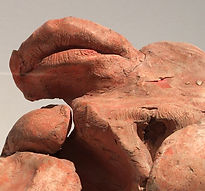
Pamiatka (Souvenir) 1971
Polyester resin, fibreglass and photos

A Szapocznikow
Sans Titre/Without title (Love 1970)
Polyester resin, and gauze
%20c_%20196.jpg)
A Szapocznikow
Detail Pamiatka (Souvenir) 1971
Polyester resin, fibreglass and photos
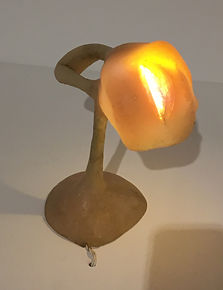
A Szapocznikow
Sculpture-lampe X c1970 Polyester resin, light bulb, electric wiring and metal
My gesture is addressed to the human body, ‘that complete erogenous zone,’ to its most vague and ephemeral sensations. I want to exalt the ephemeral in the folds of our body, in the traces of our passage’ Alina Szapocznikow March 1972
The exhibition is two smallish galleries of the work of Alina Szapocznikow (1926-1972) representing the last decade of her sculptural practice. The majority of the works are small sculptural pieces displayed in showcases together with a shelf of six of her ‘sculpture-lamps’, a series of photographs of her miniature chewing gum sculptures, a free-standing sculpture and a wall piece. Szapocznikow uses a variety of materials from bronze, plaster, clay and polyester resin with embedded black and white photographs and gauze.
The work, all based on the body, elicits a diverse set of responses from humour to a something disturbing erotic, as on closer inspection disembodied lips and breasts are revealed cast in translucent polyester resin. Some works have black and white photographs of the artist embedded in them in works that are obviously autobiographical but speak also to something beyond a personal story.
Both visceral and sensual, the work has strength and once the artist’s ‘lived experience’ is understood some clues to the power of the work begin to emerge. As Griselda Pollock cautions in ‘After-Affects, After-Images: trauma and aesthetic transformation in the virtual feminist museum’ link it is important not to offer a ‘biographically reductive’ interpretation of the work. In the chapter ‘Traumatic encryption: sculptural dissolutions’ Pollock puts forward a much more compelling interpretation of Alina Szapocznikow’s work, which she argues was indecipherable in its own moment but is now possible to re-assess in the ‘afterword’ of feminism and Holocaust awareness.
Alina Szapocznikow born a Polish Jew, was a Holocaust survivor: though she never spoke directly of this experience in relation to her work she spent from 1939 – 1945, between the ages of 14 to 19 years, working as a nurse alongside her mother, a doctor, in the ghettos and subsequently various concentration camps. After the war she trained as a sculptor originally working in traditional materials and making the type of monumental sculpture endorsed by post-war Stalinist Poland, then influenced by the avant-garde she began to work more experimentally with new post-industrial materials such as cement and polymers.
Her work does not reference her status as a holocaust survivor directly instead at first glance it can be seen as embracing life through its sensuality and humour. The coloured polyester resin and the sculpture-lamps have a bodily warmth, reinforced by internal lighting and the detail in the casts of the lips and nipples. But the detached body parts and disintegrating bodies are also disturbing expressing something of the Eros -Thanatos duality (the life instinct / death instinct) described by Freud. In this it is impossible to separate Szapocznikow’s work however apparently personal from the generational and geopolitical landscape against which it was created. In this we are forced to acknowledge Pollock’s assertion that Auschwitz was ‘a trauma for Western culture’ link.