Simon Callery, 10 June 2020
__________________________________________________________________________________________________________________________

Simon Callery Flat Painting Bodfari 15 Caput Mortuum 11
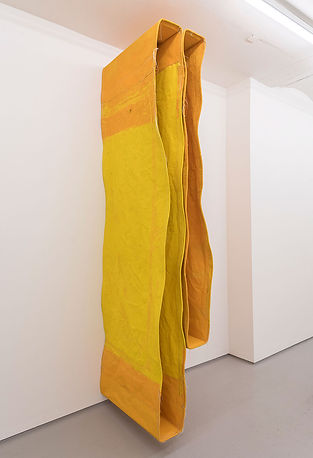
Simon Callery Stepped Wallspine Yellow Middle
.jpg)
Simon Callery making canvases, Bodfari 2018
I really enjoyed this lecture by Simon Callery on his work and its development across his career along with his process. I had looked at Callery’s work before but the connection with what I am currently attempting became more apparent during his talk. The starting point for his work is archaeology though it is not about archaeology it is a response. The physicality of the work is extraordinary even in photographs and what he said about it felt very pertinent to my textile work.
The majority of the pieces he showed are huge stitched canvases that hang at 4.5 metres high, with holes punctured through multiple layers of intensely coloured canvas. Each piece is based on a single colour but due to the way Callery ‘works’ the canvas the colour varies in intensity across it, creating a rich and vibrant surface. The colours are inspired by the ‘landscape’ of the archaeological sites that are his starting point. Callery talked a lot about how important the physicality of the work is to him; his intent is to intrude into the viewer’s space and make them engage physically with the work moving around the canvases, peering through the holes and looking around the sides. By doing this the viewer is forced to connect bodily with the work that operates at a very physical level. The interior said Callery is as important as the face of the work and should be experienced equally with the outside surface.
Callery has worked alongside archaeologists on excavations since a residency with archaeologists from the University of Oxford, early on in his career. Now this has become a major part of his process. It was great to see how something like this, which was apparently serendipitous has become so important. When on an excavation Callery works on the canvases on the ground, on site, tracing the pits, holes and signs of human activity unearthed by marking and puncturing through the canvas laid over recently excavated trenches. He works on digs where the archaeologists know him and he can be given the access he requires. Callery emphasises he is not trying to say something about archaeology but using this to develop ideas about painting that challenge tradition and keep painting alive. There is something temporal about the work that is suggested by the aged appearance of punctured and stitched canvases.
In the ‘Wall Spine’ series the work is hung at right angles to the wall, in loops like a huge vibrant roller towel seen side on. To fabricate the work he uses 15oz cotton duck washed to take out the ‘starch’ conditioning out and then soaked with distemper. He described how it’s all about getting the pigment into the canvas, the end result when the distemper has dried, is a very flat non-reflective surface. To piece the huge canvases together he stitches them on an Industrial sewing machine: as he describes this I can almost feel the pleasure of doing this stitching to bring the works together.
The canvases look soft something that continued to fascinate me beyond the end of the talk and on into the next week. I experimented with applying distemper to raw canvas towards the end of Unit 1, but it resulted in very stiff canvas, which meant I abandoned it as it did not work for the type of stitched and stuffed pieces I wanted to make. I emailed Simon directly to ask him about this and he replied with lots of useful information:
‘the distemper does make the canvas stiff. Sometimes this can be a useful quality and other times not. I will use the rigid canvas for parts of the work that I want to hold its form since I don't often use traditional stretchers. Distemper is rabbit skin glue and powder pigment - I am sure you know. So, I use very traditional painting materials but reassign them to different functions. My rabbit skin glue is used as a medium rather than as a barrier (or primer) between the canvas and the medium as in oil painting, I use it to impregnate the fabric with colour, so the colour is physically unified with the support. If you use acrylic binders they will remain stiff and always retain a plastic quality. Dying the material means you can have completely soft material with a result similar to clothing. Have a look at Franz Erhard Walter's works - all his work is dyed.
I always wash my canvas (I use 15oz canvas on rolls) first in hot water to remove the starch the manufacturer puts in it to make the threads stiff enough to weave. It drains out as a dark yellow liquid. Once the starch is out, the canvas is soft and open, and I brush or sponge in my distemper - which once dry makes the canvas stiff again. As I work outside quite a lot I leave my canvasses out exposed to the weather to soften. The stiffness is broken down and I sometimes push this further by rewetting the sheets. I have found that some pigments require less rabbit skin glue to fix them in the canvas and some pigments need more. All the Mars colours (and Caput Mortuum) for example are iron based so they need stronger size than cadmium based pigments or the earths (Burnt Umber, Raw Sienna, etc). I think the size of the pigment particle is a factor in this. Either way I try to find a point where I can break down the rigidity of the canvas without causing the pigment to loosen. I colour large sheets of canvas and I am very physical with it and not precious at all. I do not get anxious about the canvas getting marked during the making process. As a matter of fact, I encourage it, as I like to reveal all evidence of how a work has been made.’
This definitely inspired me to do some more experimentation and to reflect on the exact qualities I want my work to have. Looking at some images of Franz Erhard Walther’s work I can see a connection and will do further research into him. Walther’s work is different from Simon’s as he uses single flat colours with none of the uneven variation that Callery’s canvases have. What I want is my ‘canvases’ to have the depth and unevenness of colour of Callery’s perhaps with even more ‘texture’ that includes drips of paint or distemper. It is very useful to reflect on this through looking at the work of other artists.
Simon ended by talking about how he sent off about 40 letters before getting his first residency, his advice was to keep trying and use the fact you are doing an MA at Camberwell! He also described using the receipt of initial funding to build more, it was a nice encouraging note to end on!