Women's Work: Eva Hesse, Anna Maria Maiolino, Doris Salcedo and the power of
small works, materiality and the importance of process made visible
__________________________________________________________________________________________________________________________

Doris Salcedo A Flor De Piel, 2011-2012
Rose petals and thread, 627 x 1100 cm

Eva Hesse, detail studiowork
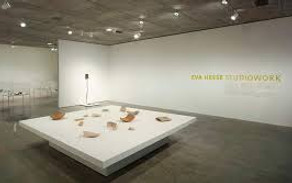
Eva Hesse, Studiowork
Fruitmarket Gallery, Edinburgh 2009


Anna Maria Maiolino, Continous
Camden Arts Centre, 2010
Anna Maria Maiolino
Detail, Continous
'Excellence has no sex' 1
Eva Hesse
The Covid-19 ‘stay at home policy’ has prompted some contemplation of working in small spaces and reflection on the often surprising power of small works. Women artists have frequently through force of circumstance worked in small or improvised studios spaces and of necessity have produced small works the power of which is not to be overlooked.
Small works have been essential to the practice of Eva Hesse and Anna Maria Maiolino and though their practices have employed these in very different ways, exhibitions of their small works demonstrate that exhibiting these on mass can be profound effect. Doris Salcedo also masses objects to profound effect, though it is the commonplace rather than the handmade in which she is interested. However, the memory of human touch is important to her practice and like Hesse and Maiolino there is a phenomenological aspect to her work. She like them, massed together many objects, installations that evoke deeply emotional responses, causing us to consider questions of the nature of existence and loss.
United by the tactile power of their work and the groupings of objects, the similarities and differences between these three artists’ work can be determined by examining three specific exhibitions of their work:
Eva Hesse ‘studiowork’ Fruitmarket Gallery, 2010
Anna Maria Maiolino’s ‘Continuous’ Camden Arts Centre, 2010
Doris Salcedo ‘Acts of Mourning’ Irish Museum of Modern Art, 2019
During the course of her short career Eva Hesse made many experimental works or ‘studioworks’, that are now understood to be an important part of her practice. She referred to them as ‘samples’ not test pieces, a term which has been posthumously applied to them and has for a long time undermined their status, suggesting they were maquettes for unrealised larger works. Using many materials that have since begun to deteriorate such as latex, fibreglass, fabric, cable and thread, Hesse displayed the works in her studio. She arranged and rearranged them in groups, together with everyday ephemera, either in glass vitrines or on a table constructed for the purpose by the artist Sol LeWitt.
Full of allusions to the body though they are not recognisable body shapes, it is the sensual nature of their making which holds bodily references. Seeing them together brings an awareness of how viscerally material some are ,whilst others are unbearably ephemeral. In all there is evidence of the repeated actions of threading – folding – cutting - piercing and winding; gestures that reveal Hesse’s process of ‘thinking through making’ and in turn make the process evident to us. They are intimate, bizarre and often erotic and invite us to think about the impulses that drive the making of art. Her experimentation with industrial materials such as latex and fibreglass, do not bring to mind modern, mechanized, manufacturing processes but instead defy these and lead to consideration of the human touch, the objects, and our own fragility, now more than ever as the materials she used are in some cases in an advanced stage of disintegration.
Contrast this with Anna Maria Maiolino’s exhibition ‘Continuous’, where evidence of the artist’s hand is also visible just as in Hesse’s ‘studioworks’.. Yet in comparison Maiolino’s gesture brings our attention to ideas of mass production through the vast quantities of clay objects formed into the basic shapes used in the production of ceramics. They focus us on the idea of repetitive, everyday tasks. and allude to ideas of the individual and society. Each piece retains the distinctive marks of its hand manufacture whilst collectively they create a single imposing structure.
Doris Salcedo connects the work of Hesse and Maiolino by using both ideas of mass production and an evocation of the body in her practice. She takes often commonplace objects and makes us powerfully aware of the absence of a once present human touch.
‘I work with materials that are already charged with significance, with meaning they have required in the practice of everyday life…then I work to the point it becomes something else, where metamorphosis is achieved.’
The materiality of works such as Flor de Piel – a carpet of dried rose petals, the colour of dried blood, painstakingly stitched on to a fabric ground and laid on the gallery floor - and Disremembered – achingly fragile shirts composed of raw silk and hundreds of needles, left limply hanging on the gallery – convey through their massed fragility ideas pain, trauma absence and loss.
This profound focus on materiality, an interest in the power of grouping objects and making the human touch visible are all fundamental ideas that unite the work of Hesse, Maiolino and Salcedo link
1 Vanessa Corby, Eva Hesse (2010). “Eva Hesse: Longing, Belonging and Displacement”, p.34, I.B. Tauris