17 March 2020 Under the skin: Anatomy, art and identity, Royal College of Physicians
__________________________________________________________________________________________________________________________

Illustration of the cardiac nerves of the right side in Tabulae neurologicae. Dissected and drawn by Antonio Scarpa and engraved by Faustino Anderloni. Published Pavia, 1794
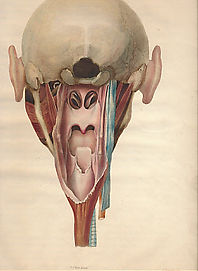
View looking out from inside the head
Anatomy of the head, in Anatomico-chirurgical views of the nose, mouth, larynx, & fauces
Dissection and text by John James Watt, drawing by T Baxter, engraving J Hopwood, published London 1809
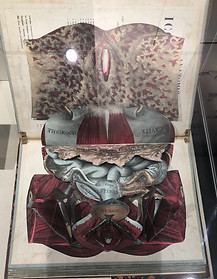
Anatomy of the female abdomen and reproductive organs. Gustave Joseph Wilkowski. Published Paris 1874

Angela Palmer
Heart, 2018. Ink drawing on glass sheets
Based on MRI scans taken at the Visible Heart Laboratory
University of Minnesota, US

Rebecca Harris
Deep seated anxiety, 2012
Stitched textiles
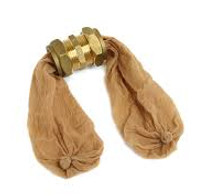
Rebecca Harris
Untitled (connector and tights) 2012
Tights and brass plumbing connector
This is an exhibition of contemporary artworks displayed alongside historical books and drawings which show representations of the human body. It aims to give visitors the opportunity for personal reflection on medical representations of our insides.
The works displayed were produced as specialist teaching tools for doctors, educational books for the general public and in the case of the artworks, a personal response to our bodies and the way they function. The anatomical representations attempt to communicate objective truths, but they also expose questions about identity and consent. Whose bodies are being used, and who controls how they are depicted. Physicians, surgeons, artists and printers have developed diverse tools and techniques to represent the layers of the three-dimensional human form, ‘Their works can evoke feelings of delight, disgust, fascination and horror.’
It is clear that we are fascinated by the contents of our complex and fragile bodies. The exhibition makes clear the long history of drawing as a learning and teaching tool in the dissecting room as well as showcasing images obtained by the less invasive diagnostic tools used in contemporary medicine such as ultrasound and magnetic resonance imaging (MRI) scans. The anatomical art captures the shapes, structures and textures of the organs and tissues that are hidden beneath our skin in contrast the contemporary art offers the chance to contemplate our bodies and is often the result of the artist’s personal experience of their body going wrong.
Seeing the contemporary works alongside the historic made clear the fascination that both anatomical illustrators and contemporary artists have with the body but also highlighted the contrasting motivations for making the work, the first concerned with showing in detail what our insides look like and the latter with the psychological relationship we have with our bodies. Interestingly these sometimes blurred as though the motivations were different the emotional response we have seeing a blurry ultrasound scan of a baby in the womb cannot be denied.
The exhibition evoked delight at the ingenuity of the anatomical illustrators who chose to show views through our bodies that when living we would never see as well as their use of simple paper technology (lift the flap and cut-outs) employed to make clear how the body parts fit together in three dimensions.
The contemporary artist’s were exploring through their work complex issues to do with our subjective relationship to our bodies, body image and the disorientation we feel when things go wrong. They were able to convey a sense of the fascinating beauty of the insides of our bodies by mediating images of things we find hard to look at if they are direct images, photographs or film footage of ‘under the surgeon’s knife’. This connects the motivations and ideas behind my own work, the shock and fascination we have for the inner workings of the body and for me a sense of wonder of the healing powers of our own bodies. The works also and essentially raise ideas about the nature of existence and, in the medical context of the Royal College of Physicians, confront us with our own mortality. This feels particularly pertinent with Covid-19 raging, I managed to visit only a couple of days before the Royal College of Physicians museum collections closed to visitors.
Some examples of the contemporary works are:
Rebecca Harris ‘Deep Seated Anxiety, 2012’ From the series of on-going works about obesity, is a soft sculpture focusing on the female centric area of the body which aims to unite the interior and exterior of the scrutinised fat female body. Seeing Rebecca Harris’s work in the exhibition led me to research her work further, I find that through her choice of materials she manages to powerfully conveys a sense of the visceral body and our body’s fragility.
Angela Palmer 'Heart' is inspired by legendary anatomist, William Harvey and is created by layering line drawings made from an MRI scan of a human heart.