Two encounters with Helen Chadwick's Enfleshings I & II,
one online and in reproduction the other a viewing at Tate Britain


Enfleshings I and II, Meat Lamps series
Text One: a response to the work viewed in photographs, online and through
the descriptions and critiques of others
2-3 August 2020
Helen Chadwick’s Enfleshings diptych is composed of two large photographs approximately one meter square each is a close up image of a piece of meat, displayed on a lightbox. The image on the left has behind it just below the centre an intense light which looks like a carbon filter lamp, with an internal coil visible through the flesh of the meat. The meat appears to be stretched out and incredibly thin, the camera is zoomed in and the over life size images covers the whole surface of the lightbox. The edges of the light box and framing are not visible as the photograph I am looking at has been taken flat on.
The colour looks of the meat varies depending on which reproduction I am looking at. On the Tate website it looks too yellow for meat, but on the cover of the book ‘Enfleshings’ it is the deep, bloody red brown of butchered flesh. The fleshy details are inescapable at the scale of the reproduction, the construction of the muscle and fat is what the eye examines. It is both so close up it is a distortion and becomes landscape but also so meaty it makes me acutely aware of the body I am in as I look at this, assumed to be, animal flesh. It is sexual the creases and crevices reminiscent of a vulvic opening or the inside of a body normally invisible without butchery or medical investigation. There is no hint of squeamishness from Chadwick who must have handled the meat, laid it out precisely as she wanted it to take this photograph, there is nothing accidental about the image, it has been planned.
Woman to woman I applaud Chadwick and her, imagined, no nonsense attitude to the meat, her refusal to be cowed by ridiculous gender stereotypes that might suggest women are too sensitive to behave so boldly. A dichotomy not borne out by menstruation, birth and the care given by women to others that makes this corporeal reality women’s daily experience. Chadwick’s other work such as Carcass a glass tower of decomposing kitchen waste confirms she has no hesitation working with these materials. In The Oval Court’ an installation at the ICA she assembled a rich cornucopia of photocopied images of her nude body together with dead fish, rabbits, maggots and seaweed, arranged in swirling Baroque ‘pools’ of plenitude. As Marina Warner comments in this work Chadwick subverts the ‘Vanitas’ tradition and using the female nude body not to chastise women for their addiction to pleasure as in the Northern European Calvinist tradition but instead to embrace transient worldly pleasure.
Enfleshings I and II radiate with the warm light of living flesh though the impossibility of the image signals the flesh is dead. Like much of Chadwick’s work this leads us to consider the cycle of transformation and decay, transience and the body’s vulnerability.
Text Two: A summary of the differences of seeing Helen Chadwick’s Enfleshings I & II
at Tate Britain as opposed to in reproduction and online
4 August 2020

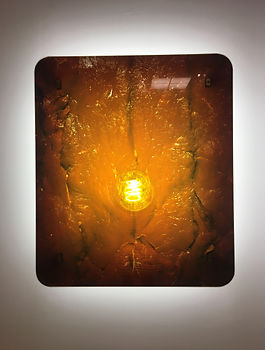
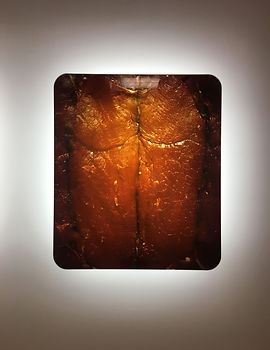
Enfleshing I & II, 1989
Tate Britain (Photo Ingham 2020
Enfleshing I, 1989
Transparency on Lightbox, 1066 x 915 x 180 mm
Tate Britain (Photo Ingham 2020
Enfleshing II, 1989
Transparency on Lightbox, 1066 x 915 x 180 mm
Tate Britain (Photo Ingham 2020
Standing in front of the work the impact of the images is far greater than in reproduction because of their physical form and materiality. In the gallery space (they are placed on a white wall at the end of the gallery with lots of white space around them) their form - their physical size - is very imposing. The are big compared to the size of the viewer, wider than my shoulders and placed at eye height. Not only their physical size but their materiality is imposing: the shiny glass and the light behind the photographs exaggerates the wetness of the flesh, suggesting it is just dead and fresh. The phenomenological power of the images ‘touching with the eyes’ is compelling, the imagined feel of the soft cool flesh and the sound of the squelch when doing so is ‘visible’. The crevasses, rips and gashes are far more apparent when standing in front of the works than on a screen or in reproduction. They are more sexual and Enfleshings I more vulvic it makes me think of speculums and self-examination/investigation. The authorial hand is also a forceful presence, in the ‘visible’ feel of the flesh and in the viewer’s mind the work induces thoughts of how it must have felt to place and spread the flesh in preparation for taking the photographs. The flesh is so present that it feels almost like a transgression to be examining it in detail and when children come into the gallery I feel they should have been pre-warned of what they are about to see. I do not find the images repulsive though I imagine some do.
and this engenders/arouses/incites/induces
The light boxes are open behind the glass the photographs are rear-mounted and fluorescent tubes visible from the side. It is also possible to see (unlike in reproduction) that the sparkler like trail of light just below the centre of Enfleshings I is not it is not a carbon filter lamp, so beloved of Hipsters but is embedded in the actual image, part of the photograph, perhaps created in the processing. I am not sure about the rounded corners of the glass it seems like a weirdly dated 1980’s design fashion (they must have a radius of 10cm) and they interrupt the photographs seamless fit to the glass. The brass fixings through the front although they too have a dated appearance, the method works like skewers pushed through the flesh and the way they float off the wall is perfect adding to their unreal appearance, the incongruity of seeing meat in the gallery.
I want to ‘BowDown’ to Chadwick glad she made these images that resonate with me. I wonder what work she would be making now if she had not died so young. The images make me feel courageous, able and wanting to look, to embrace the corporeal reality of the body.
I appreciate the audacity of the images. The power of the colour is acute, not fresh blood red but the reddish brown of meat, flesh and stem cells. They vacillate between human and nonhuman dead and alive, repulsion and pleasure and lead to considerations of the fragility of the body and an understanding that we like animals are ultimately our biology, meat. Link
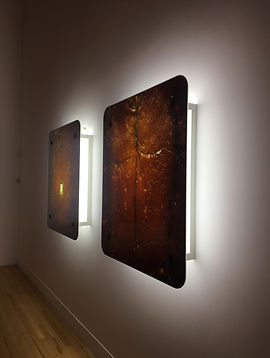
Enfleshing I & II, 1989
Viewed from the side, lighting visible,
Tate Britain (Photo Ingham 2020