UNIT 2 STUDIO PRACTICE January - May 2020
15 May 2020 Moulds for wax and plaster
__________________________________________________________________________________________________________________________
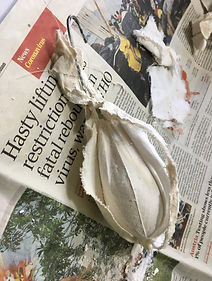

Stage 2 making plaster drops
Removing or unpeeling fabric bag from dried plaster, 13 May 2020
Stage 1 making plaster drops
Handmade fabric bag made as mould, then liquid plaster poured in and
allowed to dry, 10 May 2020


Stage 3 making plaster drops
Plaster drop once removed from fabric bag mould, 13 May 2020
Moulded wax drop, formed in the same way as plater drops
13 May 2020


Plaster 'drop' painted with Aquacyl and
acrylic medium
15 May 2020
Detail of painted plaster revealing stitching and imprint of fabric mould
15 May 2020
Day 53 of Covid-19 complete 'lockdown'.
Total number of deaths in the UK 33,614, 428 reported in the last 24 hours. Some relaxation of the lockdown measures have been announced but there is a lot of concern about the effect they will have.
This week I have made some moulded plaster and wax pieces to use alongside the stuffed fabric pieces I have been using in my recent assemblages. I want them to have weight but to have the same aesthetic as the stuffed fabric pieces that make up ‘Happenstance’. To achieve this I stitched together some fabric bags, made in the exactly the same style as the stuffed shapes on ‘Happenstance’ and used these for moulds. Once made I poured wax into some of the moulds and plaster into others and then left them to dry. One of the bags I painted wax directly on to the outside leaving the bag hollow, this one does not have any weight to it, but it has a translucent quality that I will experiment with further. The plaster forms take on the exact texture of the fabric mould including the seams and stitching. I made some bags with internal seams and some with external seams, just like the shapes on ‘Happenstance’, the plaster moulded in bags with internal seams have a fissure left in them once I have removed the fabric and pieces of fabric get caught in these cracks adding to their corporeal feel. The wax forms or ‘drops’ have a similar weight, but the imprint of the fabric mould is not as clear however the texture and appearance of the wax is innately bodily. Both types the plaster and wax, worked well when attached to ‘Twisted Form I’ link: when suspended they animate the spring in the wire and when sitting the moulded ‘drops’ act as weights so it can be balanced precariously on a table, ledge or plinth, this makes it ‘come alive’ in a different way. There is a lot more here to explore in the next few pieces I make when I will combine fabric ‘drops’ with plaster and wax ones. I will also make more wax coated bags and I will try lighting them internally as well as experimenting by adding pigment to the warm wax before painting it on. I have tried painting the plaster shapes with Aquacryl in acrylic medium too, this worked well adding to their sense of the corporeal.
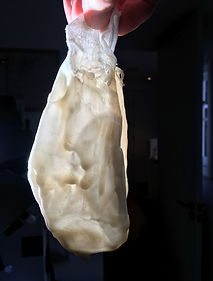
Wax drop lit externally
Fabric bag painted with wax
10 May 2020
3 May 2020 Moulded Wax Forms
__________________________________________________________________________________________________________________________
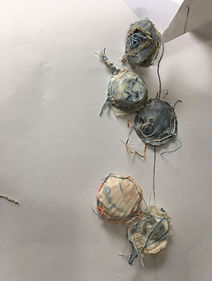
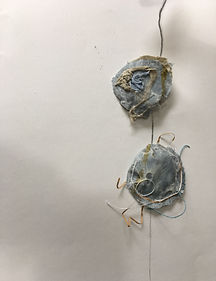
Moulded wax forms I, III,V, IV and II (left) and I and V r(ight)
Wax, fabric, thread and shredded paper
Photographed on paper with graphite line
27 April 2020
Approximately 7cm diameter and 2 cm deep each

Twisted form I in progress
positioned on the ground
28 April 2020
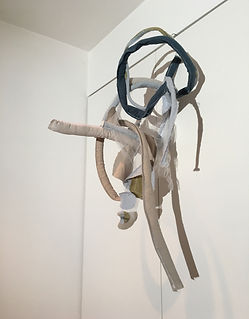
Twisted form I in progress, hangingl
Fabric, wired, stuffed and painted with Aquacryl
42 x 76 x 32 cm
29 April 2020
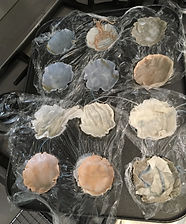
Making moulded wax and plaster forms in jam tart tins!
27 April 2020
Day 40 of Covid-19 complete 'lockdown'.
Total number of deaths in the UK 28, 446, deaths reported in the last 24 hours 315.
More research on Eva Hesse following reading the transcript of her interview with Cindy Nemser. I have been listening to the Getty Recording Artists series ‘Radical Women’ as recommended by Dan Sturgis. The recordings are very interesting in the episode on Eva Hesse: Oh, More Absurdity the host Helen Molesworth, artist Mary Weatherford and art historian Darby English discuss clips of the Cindy Nemser interview. Hesse talks about absurdity in terms of the absurdity of her life – the upheaval of her childhood escaping Nazi Germany, going back as an adult and then her recent illness – as well as her practice.
In the studio (that seems to have become the whole house!) I have been making moulded wax and plaster shapes in jam tart tins to attach to Twister Form. I dipped pieces of fabric, net and thread into the shapes as I was making them, and this resulted in some great textures. The contrast in weight between the very light wax shapes and the heavier plaster ones will be good to experiment with as I attach them to the twisted forms I have in progress and see how I can make them play with the springiness of the wire. The wax pieces have a translucent quality and where I painted on rather than dipped the fabric in the wax it has left some areas of the fabric uncoated giving them two different qualities of translucence, I will try making larger shapes in this way. The finished works will hang so the light can come through them wax, net and wire mesh – that I am still waiting to be delivered. I have already been playing around with this, I am finding it quite good to live with them hung up in different ways so I can think through the different ways I might hang and prop them and the advantages and disadvantages of each method.
Following a tutorial with Geraint this week, when we discussed different methods of moulding plaster and wax at home, I have started making some inside out ‘bags’ in the same style as the shapes on Happenstance. I am going to see if I can use these to make plaster shapes that will have the imprint of the stitching and seams on them.
At the end of last week I had a great email conversation with Jelena Bekvalac from the Museum of London link. She has given me access to some x-ray images of the bones I was drawing when I visited. We had discussed these when I was at the museum, but I did not think she would be able to let me have them while working remotely. It felt great to get them, a sign that research can continue even during lockdown.
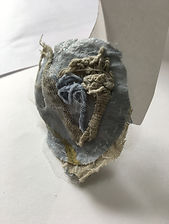
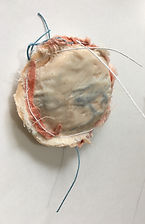
Moulded wax forms I detail
Wax, fabric and thread
7cm diameter, 2 cm deep
27 April 2020
Moulded wax form IV detail
Wax, fabric and thread
7cm diameter, 2 cm deep
27 April 2020
19 April 2020 Three dimensional drawing
__________________________________________________________________________________________________________________________

Inside drawing IV with three dimensional form, 16th April 2020
Aquacryl, ink, graphite stick, pencil and wax on paper, with
stuffed and wired textiles
70 cm wide x 100 cm high x 260 cm deep
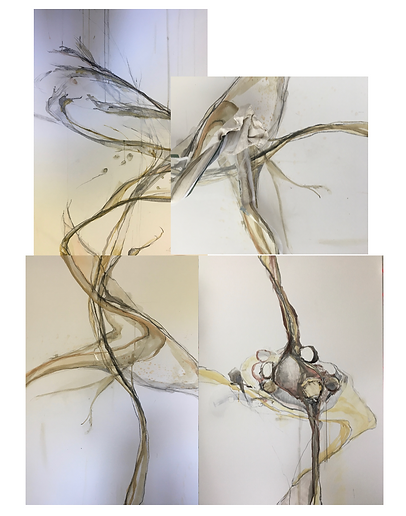
Inside drawings III, IV and V
AI drawings, collaged together with three dimensional drawing
Day 27 of Covid-19 complete lock-down.
Encouraged by reading Eva Hesse interviewed by Cindy Nemser and watching Letters Live, ‘Sol LeWitt to Eva Hesse’ - Read by Benedict Cumberbatch
https://www.youtube.com/watch?v=VnSMIgsPj5M link I set myself the goal of moving between drawing and three dimensional ‘samples’ again this week, without thinking too much about where each piece is going. It had some surprising results. I am also experimenting with a new colour palette, moving away from using reds and pinks and their obvious bodily connotations. I am interested to see how or if this changes the interpretation of my work. It will be good to test this at the Group Crit next Friday link .
Came close to overworking a drawing and found switching to making three dimensional pieces helped. Was very surprised when I placed one of the three dimensional pieces on ‘Inside drawing IV’ and realised that it extended the drawing off the picture plane. The piece is not resolved but it is an exciting development. It has shifted me back into obsessive making. I have dyed some more fabric and have been painting on them with Aquacryl with interesting results. I have started painting on the three dimensional pieces I am making, a bit tentative at the moment but I definitely will do more.
I have been ‘stitching’ together photographs of the A1 drawings I have been making. No space to put them all up together in my home studio but quite exciting to see that they link up, it would be great to install them like this at some point.
Finally, I have been developing an idea for a collective artwork that will be a response to the Covid-19 lock-down link. I have written a brief and this week sent it out to friends and family. In it I have asked them all to make a simple handmade object whilst in lock-down to contribute to a collective artwork. I have said it should be easy to post to me in an A5 envelope and have asked everyone to pass the brief on to anyone else who might participate. The results are to be returned to me by 15 May 2020. I feel nervous about the number of responses I will get but the element of surprise or disappointment is something I want to take account of when I put the resulting work together. Covid-19 cannot pass without becoming part of what we are all doing as artists link.

In the studio, Inside drawing IV with three dimensional form (left) and
Inside drawing V (right)
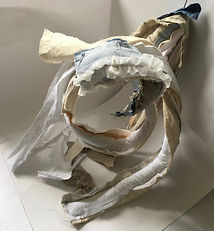

Twisted Form I, II and III, 17th April 2020
Drawing in three dimensions
Samples, stuffed and wired textiles, painted with Aquacryl
11 April 2020 Drawing and Reflection
__________________________________________________________________________________________________________________________
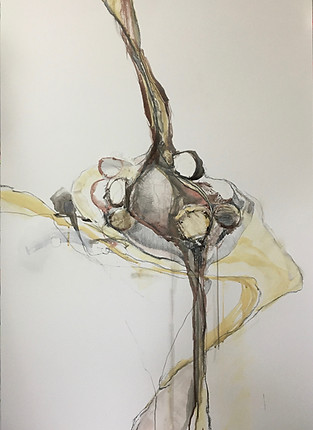
Inside drawing III, 9th April 2020
Aquacryl, ink, graphite stick, pencil, wax
and paper collage on paper
70 cm x 100 cm
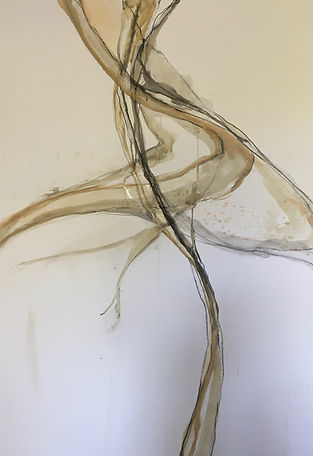
Day18 of complete lock-down, 3 billion people around the world are now in lock-down according to ‘Coronavirus: The Evidence’ BBC World Service (4 April 2020). 9,000 people are known to have died of Covid-19 in Britain and 900 people in Britain died yesterday, these things are impossible to ignore.
The lock-down has prompted a moment of contemplation. Further exploration of the small ‘studiowork’ of Eva Hesse l (The Fruitmarket Gallery, Edinburgh 2010) has led to a pause before diving in to making another work and I am enjoying using the time to explore some ideas through drawing and making my own ‘samples’ (Hesse’s term for her small ‘studiowork’). Removing the pressure to produce large pieces has enabled to really explore the properties of the materials I have at my disposal. Having rearranged the studio so I can make large drawings and sew in parallel means I can move back and forth between drawing and making three-dimensional objects. It is early days, but it seems to have led to a greater connection between thinking freely (through drawing) and working out what shapes and textures I want to and can make, in other words one activity seems to be feeding the other.
Immersing myself in Doris Salcedo’s work – reading about her, watching her speak and Judith Butler speaking about her too – has led to an acute awareness of the importance of the selection of materials. Judith Butler describes how Salcedo’s makes visible the absent body and the violent killing of those she is ‘memorialising’ by for instance ‘crafting’ wooden chair backs out of metal stakes or unwearable shirts out of steel needles. In this way, according to Butler she manifests both the killing and the memorial at the same time link.
Shadows of the Absent Body a lecture by Judith Butler 2017
Harvard Art Museums: Topography of Loss: A Symposium on Doris Salcedo held during the exhibition The Materiality of Mourning
https://www.youtube.com/watch?v=9o9_ZP2Z7aI
[Accessed 6-04-2020]
Sample I, 9th April 2020
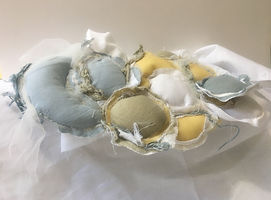
Textiles and latex stuffed with kapok
21 cm x 26 cm x 4 cm
Inside drawing IV, 10th April 2020
Aquacryl, ink, graphite stick, pencil, wax
and paper collage on paper
70 cm x 100 cm
3 April 2020 Home Studio
__________________________________________________________________________________________________________________________
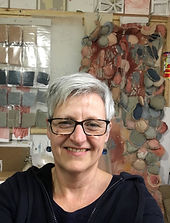
In home studio, 30 March 2020

Louise Bourgeois1975, wearing latex sculpture Avenza 1968-69

Roman - Artemis of Ephesus
Roman copy of original
2nd century AD
Bronze alabaster 118cm high
Musei Capitolini, Rome, Italy

Sketch of Artemis
18th or 19th century
British Museum

Artemis of Ephesus
125-175 AD. Marble
Ephesus Museum, Selçuk,Turkey
Day 11 of complete lock-down. Confined to the studio at home I am taking a moment to reflect, my research has been surprisingly fruitful this week and supplies are rolling in ready for making my next piece.
On Monday we had a ‘Painters Virtual Meetup’ on Skype, eight of us joined. it was nice to see other people and we’ve agreed to share work during our call next week. There was a discussion group with Dan Sturgis about Chris Martin and painters supporting each other and a course meeting with Geraint plus two separate calls with Joao and Cathy that added ideas to my current research. I have spent some time contemplating what Covid-19 might mean for my work and how I might actively engage with what is happening.
In the studio I have been thinking a lot about the reference points for my imagery, the type of textures I want to use in my next piece of work and how I might achieve them. Following through on some of the responses I have had to ‘Happenstance’ I have done some research into Artemis. I have always thought of the work as being about the body in trauma, but now I am tracing in it ideas of change and metamorphosis, first prompted by conversations with Yvonne Feng. The visual reference to the statue of Artemis from Ephesus has thrown up interesting ideas about duality. Commonly seen as solely a mother goddess, the ancient Greeks also believed her to be a bringer of disease and ‘reliever’ of it too. Daughter of Zeus and Apollo’s twin sister, Leto, her power was equal to the male gods and at her festival young girls dressed in saffron robes. There is also a surprising visual link to Louise Bourgeois latex worn pieces.
In my desk-based research I have been looking at Eva Hesse’s small ‘studiowork’ link but as I have been considering the role of light in my work and translucent materials, this has inevitably led me to look at some of her large seminal works too, such as ‘Continum’ 1969. I have been researching the British Museum’s collection of gut parkas, remembering the beautiful translucent nature of them and the detail of the way they are stitched. Being made of animal gut, they resonate with the reading I have been doing on Phenomenology and ideas of corporeality; that one is one’s body and one’s body is an opening onto the world. The tactile nature of the gut parkas is apparent, even though we are not touching them we sense the feel of them through seeing them alone. This connects with the work of Eva Hesse and Doris Salcedo whose choice of materials, though we may not actually touch the work, have a visual tactility which evokes an emotional response. The sensual nature of their work gives it a power, imbues it with ideas of fragility and loss. Though the gut parka, Salcedo’s ‘Disrembered’ shirts and Hesse’s ‘Continum’ are made from very different materials the physical sense of them is similar and gives clues to how I could employ specific materials and their treatment in my next piece. I have also been working through ideas for my Unit 3 piece and how it might engage with Covid-19 possibly becoming a communal work.

Doris Salcedo Disremembered III, 2014
Raw silk and needles
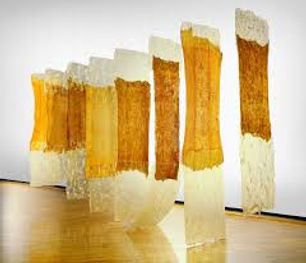
Eva Hesse, Contingent, 1969
Fabric, latex and fibreglass
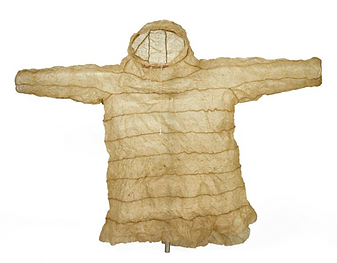
Flora Nanuk (Yupiit),women's gut parka, 1980s
Bearded seal gut and colon, beach grass
Hooper Bay, Alaska, USA
British Museum
29 March 2020 'Happenstance', www.gov.uk/coronavirus-extremely-vulnerable-guidance
___________________________________________________________________________________________________________________

Happenstance, in progress. Photographed as intended for display with light behind
Aquacryl soak-stain and dyed textiles
painted with wax, 200cm x 106cm
28 March 2020
Below, detail with light behind


Happenstance, in progress
Aquacryl soak-stain and dyed textiles
painted with wax, 200cm x 106cm
28 March 2020
Below, detail
Monday 23 March 2020 18.47 ‘NHS Coronavirus Service: We have identified that you’re someone at risk of severe illness if you catch Coronavirus. Please remain at home for minimum of 12 weeks.’ www.gov.uk/coronavirus-extremely-vulnerable-guidance....
Day 6 of complete lock-down. The world has contracted to the studio, the house and garden and a never ending stream of weird online video conversations with fellow MA students, tutors, friends and my yoga group. Everyone wants to link up and talk, I feel the need to filter and ask myself who do I want contact with, what is important to me right now? Part of me enjoys this ability to shut myself off and lose myself in my own world of making. The online seminar and Skype tutorial this week were remarkably enjoyable, though I am also aware of all that has been stripped away and I wake up early wondering if I can cast wax at home.
I have become obsessive about my work, I feel as if I am in a sweatshop constantly cutting, pinning, stuffing and stitching together ‘Happenstance’. The sewing machine whirrs and provides a strange rhythm to the days. I am covered in fluff from the Kapok, slightly sneezy but totally immersed. The piece has taken on a life of its own, I am making new shapes, learning all the time how to work with the materials in a better more interesting way, letting them lead, then resting back control and manipulating them into what I want. The colours, and blending of colours in the piece, has become more complicated as I use what was once discarded and stitch fabric remnants back into the work. This seems like a metaphor for where we are now with Covid-19, everything counts, we do not waste food, we do not waste the opportunity to exercise or the chance of connecting with others.
I think I have finished ‘Happenstance’; I have decided to set it aside as I consider whether or not to paint back into it. I definitely want to display it (if that opportunity ever comes) with light behind it. Quite apart from whether or not it is finished I have ideas for what I am going to do next and I want to get on despite the limitations of space and equipment, I want to act on my ideas.
I worry about casting wax…
Useful and interesting conversation during my tutorial with Anna Bunting-Branch about the themes of trauma in my work and how pertinent it is right now to be exploring the expression of collective and personal trauma as the world suffers Covid-19 and at the same time each of us individually has to work out how to deal with it for ourselves.
We talk about my home-studio space and it’s limitations.
I think about the Camberwell course going online and all the MA students being dispersed across the world to our own small studio spaces.
We talk about women artists’ work and the restrictions of space which has so often characterised their practice link.
I think about how I want to scream I don’t want to accept the limitations of space and rein in my ambitions.
Is it possible to cast wax at home?
But choice is what we are being deprived of and Tara Brach’s philosophy of ‘radical acceptance’ is a better route to opening up to creative possibilities. Here is an opportunity to take stock and reflect. I feel excited about my ongoing research what I will make next and how all the current circumstances will contribute to it in ways that are impossible to predict.
If I use a waterfilled balloon might it be possible to cast wax at home?
[Radical acceptance is accepting that some things are beyond your control. Many people will fight back against things they cannot control. ... While you can be upset about it, learning to radically accept what happened can help you move on with your life].
I learnt a new word ‘weltschmertz’ German for world pain.
I worry about casting wax…
20 March 2020 'Happenstance' and Covid-19
___________________________________________________________________________________________________________________


Sketch of Happenstance, planning what to do next
Photograph annotated with pencil and ink
13 March 2020
Happenstance
(Textured flat form II) in progress
Aquacryl soak-stain and dyed textiles, painted with wax
17 March 2020
Detail, Happenstance
(Textured flat form II) in progress
Aquacryl soak-stain and dyed textiles, painted with wax
17 March 2020
Detail, Happenstance
(Textured flat form II) in progress
Aquacryl soak-stain and dyed textiles, painted with wax
17 March 2020
'Happenstance - a chance happening or event'
This really is the most bizarre of times as Covid-19 has slowly closed everything down this week, no teaching on site at Camberwell, no galleries, cinemas or theatres open and now no pubs, restaurants or leisure centres too.
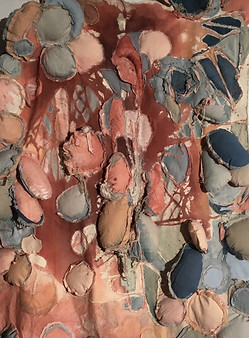
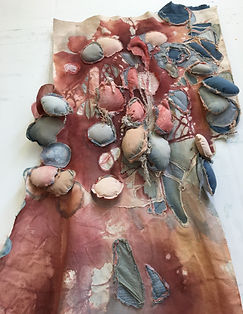
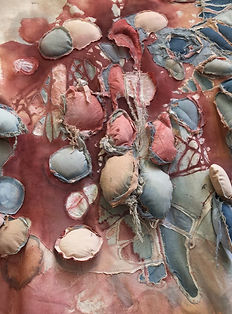
‘Happenstance’ my latest work, continues to develop. I have taken it away from the rectangular, stretched canvas format and let it drape to the floor instead . This and increasing the amount of blue tones in the appliqued areas feels like progression.
I started the week in full flow taking ‘Happenstance’, into college to paint directly on to it with the Aquacryl colours. It was great to see it with more space around it and in better daylight and I am beginning to develop a good rhythm between sewing and painting. I felt more confident painting directly onto it with Aquacryl than I had imagined I would, deepening and adding to the colour felt as if I was taking possession of it and not just working with the semi-accidental marks of the original soak-staining. However, it is quite hard to see the true full effect when it is wet as the colours appear darker. I definitely need to re-work it and make the colour bolder in some areas, but this is all part of learning how to work with new materials. Though the Copeland Gallery show will not now go ahead, I do want to work out how best to exhibit it and attach any necessary fixings to ensure, it hangs the right distance from the wall and that it drapes as it should.
I painted on Monday and part of Tuesday. I managed to fit in a visit to Under the Skin: Anatomy Art and Identity link, an exhibition at the Royal College of Physicians on Tuesday afternoon just before it closed! Once it was dry I retrieved, ‘Happenstance’ from college to do more stitching on it at home. I am hoping I might be able to use the studio for painting again next week before Covid-19 completely shuts down the studio space but it’s looking less and less likely. Having the ability to plan ahead striped away is very unsettling.
It certainly is a pertinent moment to be making work that reflects on our bodies, trauma and illness! My Unit 2 Critical Research, which explores the difference between the expression of personal and societal trauma and specifically whether it is possible or not, for both to be expressed in a single artist’s work; looks as though it will play out in my own work. As Covid-19 curtails all usual activity I cannot see how my work can fail to reflect what we as a society are going through and our anxieties about the world closing down. Recently re-reading ‘The Handmaid’s Tale’, Margaret Atwood’s 1984 dystopian novel, societal trauma is beginning to feel like the theme for 2020.
Mapping this in my own practice I am not surprised that my motivation for making work waned a little towards the end of the week. With the Copeland Gallery exhibition (due to open on 31 March) off, the Interim Show at the end of April assumed cancelled as well as the degree show in July it is hard to remain focussed. All this raises quite profound issues for artists about why we make work if all opportunities for exhibiting have been stripped away. Ensuring we can remain in touch and show our work at least to other MA students over the coming months will be paramount.
My intention is to bring ‘Happenstance’ to a conclusion as I already have so many ideas in my head for my next piece and have ordered various materials to experiment with including, silk and Latex. I am determined to create a routine if all work is now to be made at home but not having the One Day Show on Tuesday, where I was hoping to show ‘Happenstance’ for the first time, is very disappointing.
8 March 2020 Painting as Embodied Seeing: Stitching, Soak-Staining and Phenomenology
___________________________________________________________________________________________________________________

Soak-stain washed calico experiment, dipped in and dribbled on Lascaux Aquacryl
2 March 2020

Textured flat form II, in progress
Soak-stain and dyed textiles painted with wax
4 March 2020
Soak-stain unwashed canvas experiment using dripped on and wet brushed out, Lascaux Aquacryl
2 March 2020
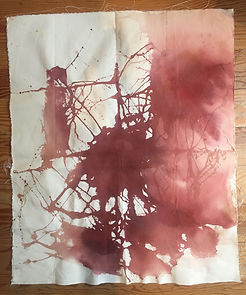
Soak-stain washed calico experiment, cloth dipped in and dripped on Lascaux Aquacryl
2 March 2020
A very useful tutorial with Yvonne Feng on Thursday (5 March) following her artist’s talk Tracing the Unspeakable: Painting as Embodied Seeing. The discussion I had with her and the way she described creating her work during her artist’s talk link really resonated with me.
In her talk Yvonne described in detail how she uses gesture and the act of making to access traumatic memories. She then talked about how gesture is also used to engage the viewer’s imagination and how this allows them to access ‘stories’ in the work. Using Gerhard Richter’s September 2005 as an example she described how Richter’s scraping action affects the viewer, how the blurring it causes ‘provokes a sense of horror in absence’.
Similar ideas are discussed in Griselda Pollock’s ‘After-Affects, After-Images: trauma and aesthetic transformation in the virtual feminist museum’ which I have just finished reading. She references Phenomenology and how we use the sense we have of a work to access meaning. For instance - our corporeal understanding - of the ‘skin’ of Alina Szapocznikow’s work - the look and the imagined feel of its texture - is used to transmit themes of trauma, both personal and societal.
My understanding of Phenomenology has developed through reading Maurice Merleau-Ponty. In his essay Eye and Mind, he explains how no scientific analysis of the world, or reflections on it, are possible without our own corporeal sense of it. My tutorial with Yvonne, hearing her artist’s talk, reading ‘After Affects’ and Eye and Mind have all combined to galvanise some of my thoughts about own practice.
I have begun to try and describe or name my work – soft, heavy, bulbous, shiny, cold and brittle – all of which are qualities I want the work to have. I want to use these to convey ideas of vulnerability and a sense of the corporeal as well as wonder and metamorphosis. I have not yet formed a ‘language’ that can do all this, but I have a better sense of what I am aiming at.
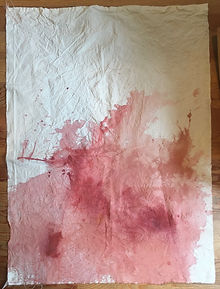
The soak staining that I did on large pieces of fabric in C131 on Saturday (29 February) and Monday (2 March) contain some of the right mark making. The runs, the accidental marks made by dribbling on the Lascaux Aquacryl colours on to pre-wet or dry fabric have a delicacy to them, a sense of the venous or lymphatic systems, or the tissues of the organs. Once the fabrics were dry I was not entirely convinced by colour which had seemed less ‘bloody’ when wet. The dry red marks seem too obvious and lose something of the quality of ‘Textured Flat Form I’ because the colours are less subtle. However, I intend to continue to work with them for the moment because they have other qualities that I like such as the type of mark. It is also to reactivate the pigments by wetting them with a brush dipped in water and then to re-work them, adding other colours or watering them down. You cannot remove the stain completely, but you can change the feel of the mark.
I have started to embroider on top of Textured Flat Form II (now named Happenstance) and although it is early days I think the shapes are more successful than the very round ‘decorative’ shapes I used in Textured Flat Form I. The shapes in Happenstance are more visceral and the way I have stitched it and added in texture works better, it is less of an embroidery piece. Yvonne questioned this but I feel happier with the shapes. Yvonne also questioned the need to retain the rectangular stretched canvas form and the use of canvas itself. Both of these I had already begun to question. I definitely intend to move ‘off the stretcher’ (or away from the rectangular format) and to trial a range of textiles and possibly including Japanese paper and latex too. I will experiment with painting on wax, varnish and acrylic mediums to add texture and make the work more three-dimensional. I want to find a language somewhere between an unsettling sense of the corporeal – the inside body made visible - and delicate beauty.
1 March 2020 Developing and refining a personal visual language
__________________________________________________________________________________________________________________________

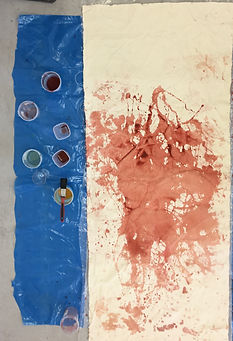
Soak-stain experiments in C131 Seminar Room
29 February 2020
Soak-stain experiment using Lascaux Aquacryl
29 February 2020

Dyed canvas, calico and butter muslin samples
23 February 2020

Dyeing blue textiles
21 February 2020
Everything in the studio is currently geared towards developing and refining a visual language to express a sense of the body and trauma in my practice. I am doing this through making drawings of medical collection material, I visited the Royal College of Physicians this week link and continuing to experiment with materials.
On Tuesday I asked for advice from Lyndsey the Sculpture Workshop technician about ways to stiffen the fabric I am using in my work, other than using wax and she suggested polyurethane varnish, which I will try although it sounds as it might be a bit shiny. I will also attend an induction for working with and making wax moulds on a Tuesday morning in the next few weeks.
On Wednesday 26 February I went to Craig Horsfield’s workshop on making dyes and pigments from natural materials. This was extremely informative, but I was put off by Craig stating what John at AP Fitzpatrick’s link had said about natural pigments fading within a few months. However, some of the substances used – pomegranate skins (green), alder husks (brown), brazil wood (red/pink) make some amazing and subtle colours so I will do a few more experiments before abandoning natural dyes completely.
I have begun to experiment with soak-staining, using the acrylics I purchased from AP Fitzpatrick, the Lascaux Aquacryl produces some really rich colours even when relatively watered down. I began by making some small samples that tried to reproduce the colours I made by combining pre-mixed, commercially available chemical dyes. I quickly moved on to working on much bigger pieces of canvas laid out on polythene on the floor of C131. I liked the physicality of the process, working around large pieces of canvas. Very quickly became fascinated by the properties of the thinned acrylic colours and the marks they make under different conditions and the way the colours could be combine on the canvas or not. Pre-wetting the canvas means you have more control over where the colour goes, and the type of marks made. The Aquacryl can be reactivated by wetting it again and this also produces creates interesting affects, as does allowing the canvas to sit in pools of colour or manipulating the runs of colour by lifting the canvas and then setting it down again. By using a combination of these techniques, I can make marks that suggest bodily trauma, bruising and oozing wounds which remind me of Berlinde de Bruyckere’s Cripplewood 2013 link. I am going to continue to do further soak-stain work in C131 on Monday 2 March.
20 February 2020 Textile works
__________________________________________________________________________________________________________________________
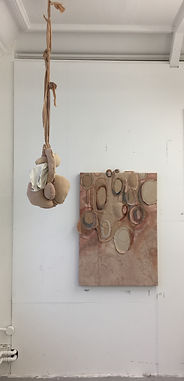
Knotted Form and Textured Flat Form
installed in C 131 Seminar Room for Group Crit 20 February 2020
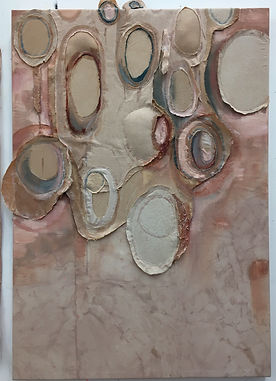
Textured Flat Form
Fabric, wax and oil paint
72 x 104 x 4.5 cm
18 February 2020


Textured Flat Form, close up
18 February 2020
Textured Flat Form, detail
Fabric, wax and oil paint
18 February 2020
A very productive week in the studio, I completed Textured Flat Form. The tutorial I had with Geraint on Tuesday and the Group Crit on Thursday were really useful. On Wednesday I visited AP Fitzpatrick in Bethnal Green link, following up on Tim Johnson’s advice. I got a fulsome explanation and lots of advice on soak-staining canvas, a la Helen Frankenthaler and in particular how to do it in the way she did later in her career using acrylics rather than thinned oil paints which involves using lots of solvent and so was not recommended! I came away with lots of samples of different types of acrylics that I will experiment with over the next week.
I had a tutorial with Geraint on Tuesday. It was a useful conversation that confirmed the direction I am going in as well as prompting me to a deeper investigation of the materials I am choosing to use in my practice and how I might help myself to understand them more deeply. Geraint suggested I tried to describe in words the feel of the sculptures or canvases I am making or just to write down words I want associated with the work. I could then use this to help me better understand what materials I want to use as well as their symbolic and metaphorical meanings. We also talked about how to narrow down my research – which seems to be happening now I am definitely allowing myself to focus on the body – and other collections I might use for reference, such as the Gordon Museum.
I found it surprising and interesting that part of the conversation focused on the craft or technical skill required to stitch and sew Knotted Form and Textured Flat Form, something which also came up in the Group Crit later in the week. This prompted me to reflect on how much I enjoyed dredging up the skills required; using the sewing machine, stuffing and wiring the three dimensional forms. I also enjoyed working out how to mix off-the-shelf Dylon colours in a painterly way to get the subtle shades of dye colours I wanted in the fabric and canvas. I experimented with natural dyes too. I explored dipping dyed fabric into wax and painting wax directly onto Textured Flat Form, the resulting effects are very successful though I am not sure how resilient they will be.
For the Group Crit on Thursday I installed Knotted Form and Textured Flat Form. It was a very useful opportunity to test the response to these latest works. Some of the words used to describe them were metamorphosis, bodily, soft, cells, womb, scars, visceral, uncomfortable, tension, I found this very encouraging. I was however surprised how much the group engaged with the canvas. They spoke about the tension between the ‘skin’ of the canvas and the things falling off it or oozing out of it and how I could expand on this and make the parts falling off more three-dimensional, a prospect I feel very excited by. There was also some talk about the craft of making, as in the tutorial I had with Geraint and very positive comments about the effects created with the combination of the dyed canvas, the appliqued ‘patches’ the wax and the oil painting, see detail. It was described as being my unique language and therefore having much more of an expression of myself embodied in it. The colour was quite well received but it was suggested that I could explore the blue more.
Knotted Form was thought to be a more familiar language but also quite positively received, hugging and enclosing were used to describe it. When I saw the two installed in C131 the seminar room I thought Knotted Form looked a bit small and lost, which was useful to observe as scale is one of the questions I am still exploring.
I submitted both works for the Copeland Gallery Open Call that Sinde has set up, it seems they will be accepted. The exhibition runs 31st March –
6 April and will be a good opportunity to test them with a slightly wider audience in the run up to our Interim show at the end of April.
9 February 2020 Off the canvas, working in three dimensions
__________________________________________________________________________________________________________________________

Knotted form (body), in progress
Cloth dipped in plaster with chemical dyed canvas and calico, wired and stuffed with polyester wadding
5 February 2020

Knotted form (body)
Cloth dipped in plaster with chemical dyed canvas and calico, wired and stuffed with polyester wadding
6 February 2020
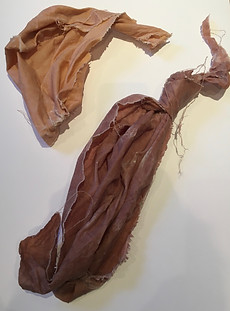
Wax dipped, dyed cloths
9 February 2020

Canvas and calico being dyed with red and brown onion skins. 9 February 2020
I can’t quite believe the way I have leapt from the gridded pieces I was making at the beginning of January to the knotted body sculpture I have made this week. It seems logical to move from fabric and bandages applied to the support to making them the support but so quickly they have become something else entirely. Working with the pink fluorescent ground led me to experiment with dyeing the canvas to create something more subtle to work with, more similar to the colour of the distemper on plaster supports I was making in December. Dyeing the canvas quickly led to the idea of stuffing and wiring it to make a three-dimensional form.
Reflecting on Knotted Form I analysed what I think is working and what is not. The successful elements are the subtle tones of colour and the contrast between the hard (cloth soaked plaster form) combined with the softer forms of stuffed cloth. However, the plaster form feels quite fragile, attaching it securely is difficult and the texture of it isn’t quite right. Hanging them feels right but the exact height and precise detail of what they are hanging from are important and need more work. There were lots of very useful conversations about the importance of the way things are presented at the BA Painting Interim Show Crits I attended this week. My immediate next steps this week have been to experiment with natural dyes, to see if I can get a greater variety of subtle colours and to attempt different ways of making the plaster form. Helen Frankenthaler’s soak-stain works are still in my head so I had a tutorial with Tim Johnson link to discuss ways in which I might stain the dyed canvas with paint, prior to making the stuffed forms.
My first natural dye experiments with red and brown onion skins resulted in a remarkably similar colour to the chemical dye I mixed. Dipping the dyed fabric into wax worked really well resulting in an object with a very visceral feel, my concern is this may still be quite fragile like the plaster, so I am going to investigate other possible materials such as cellulose acetate. Cellulose acetate is a naturally occurring polymer obtained from wood fibres or the short fibres adhering to cotton seeds.
I am continuing to read Griselda Pollock ‘After-Affects, After-Images: trauma and aesthetic transformation in the virtual feminist museum’, through reading this I discovered the work of Alina Szapocznikpow link and discovered the Hauser and Wirth exhibition which I went to see. The Sculpture Lamps and Tumour works are very visceral largely due to the selection of materials, the colour and the scale, for instance the breasts and lips are human size. The colours are not realistic, but the translucent resin and flashes of colour feel sensual and corporeal. The detail in the casts of the nipples and creases in the lips and pores visible in the skin add to the humanity of them even though they are dismembered body parts. The ‘flesh’ of the Sculpture Lamps looks warm to the touch because of the light glowing within, like a torch shining through a hand. Szapocznikpow’s work has a humour and eroticism but manages to combine this with a sense of corporeal vulnerability in an Eros/Thanatos duality. Thinking about this raises many questions for my own practice around the importance of selecting the right materials, colours and textures. It also led me to acknowledge the eroticism of Knotted Form knowing that as long as I retain an awareness if this it can co-exist with an interpretation of trauma.
This coming week I will continue to make sculptural forms but to increase the scale to human size, to investigate making casts and the use of resin. I will continue experimenting with natural dyes and will try staining and painting the dyed canvas.
2 February 2020 Exploring the body
__________________________________________________________________________________________________________________________

Gridded sinews 1.I Oil paint, plaster bandage and sheet on paper,
70 x 118 cm. 29 January 2020
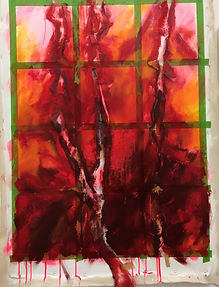
Gridded sinews 2.I in progress
Oil paint and paper with
fluorescent ground on canvas
70 x 118 cm. 29 January 2020
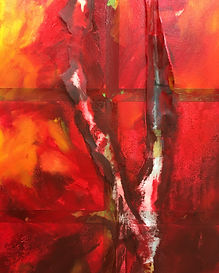
Gridded sinews 2.I in progress
detail of Japanese paper stained with oil paint. 29 January 2020

Dyed canvas
2 February 2020

Colour collage, sketch book
2 February 2020
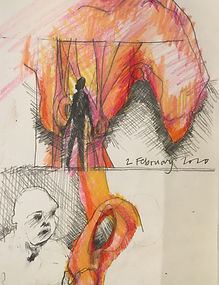
Ideas for 'body' sketch book page
Pencil and crayon
2 February 2020
Plaster and canvas 'body'
sculpture trials, close up
2 February 2020

Plaster and canvas 'body'
sculpture trials, close up
2 February 2020
I am excited about what I am attempting in the studio, it has been a week of ideas and experimentation. I have been trying to understand what is most important about the gridded pieces I started making last week and continued to work on this week, and the plaster and distemper trial pieces I made last term Distressed 2.1 and Distressed 1.I. In Distressed 2.I and 1.I, the subtle colour and the rubbed away surface is important but the neat square these are held by feels like a constraint. The gridded pieces also feel constrained by the grid, though I like the idea of peeling or rubbing away the paper, tape or surface paint to reveal something unexpected underneath (and I will still do this) but the red feels too obvious and weirdly not bodily enough.
My thinking about trauma is evolving and developing I am thinking about how the body might express trauma. This feels like quite a break-through and instead of wanting to depict trauma I want to do something more profound and create something which evokes trauma using an abstracted idea of the female body to suggest the fragility of our corporeal selves and what it is to be human.
In the gridded work on canvas I have really enjoyed the way the paint is being sucked into the Japanese paper which originally I was just using to mask out the ‘sinews’ stretching across the work. Now I want to use the paper in the work or reproduce the staining effect, perhaps staining the canvas direct. This made me think about the use of distemper and being drawn to the staining effect it has. At ‘Painting and Materiality’ one of the sessions at the ‘Conversations on Painting’ seminar held at Camberwell on Friday John Hoyland’s work was discussed. In 23.3.69 and other works he used Helen Frankenthaler’s pioneering technique of ‘soak-staining’ the canvas to create a ground link. This prompted me to go and look at the Tate’s recent hang of five of Helen Frankenthaler’s ‘soak-stain’ works link. Seeing them was fantastic, the intensity of the colour and the subtle aurora of a slightly lighter version of the colour around the dark stain, where the oil had seeped into the canvas was very interesting and reminded me of the oil paint soaked Japanese paper I’ve been using. I thought I might try this and combine it with dying the canvas with fabric dye, to create an initial subtle ground colour that I could soak-stain and then paint on. This weekend I have dyed some canvas and this coming week I will experiment with painting on it, creating layers of colour and experimenting with a variety of colours which subtly evoke the body. Thinking differently about colour will be another theme for me in Unit 2. When I went to see Rembrandt’s Light at Dulwich Picture Gallery this week link I thought about all the different colours that white flesh can be under different light conditions. I have begun to investigate the variety of colours I might use by making a sketchbook collage.
I have also started to explore in more detail how I might evoke the body. I have looked at microscope slides of cancer cells in blood. I went to look at the Science Museum’s new Medicine Galleries the week before last to see all the different types of images of our bodies that are and have been used for medical and research purposes; from wax models of the seventeenth century to MRI scans, images of the human genome and models of our DNA. These are all useful ideas to play with but what results needs to straddle the idea of body and be recognisable as the body without being a depiction of it. I am continuing to explore this, by approaching it in different ways; this weekend I have made some plaster ‘body pieces’ to paint in the studio this week and I have requested an appointment to go and draw the bones collection at the Museum of London.
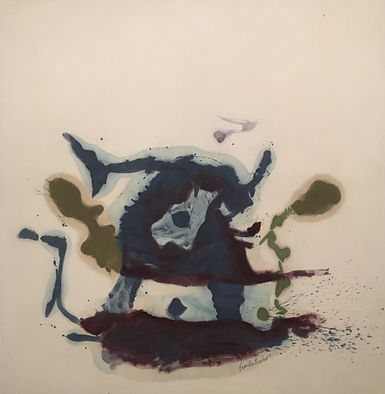
Helen Frankenthaler
Vessel 1961, Oil paint on canvas

Rembrandt Self Portrait