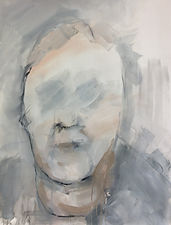
The Emotive self-portrait: an investigation into how we navigate the world and
represent ourselves at times of trauma or transition
MA Fine Art: Painting Project Proposal
25 October 2019
___________________________________________________________________________________________________________________________________________________________________
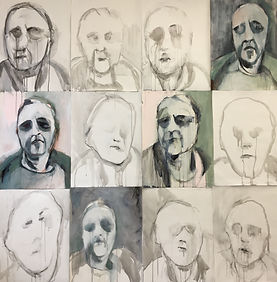
Twelve, 16 October 2019
Oil paint and ink on gesso prepared paper
224 x 204 cm
The emotive self-portrait: an investigation into how we navigate the world and represent ourselves at times of trauma or transition. Essential to my enquiry will be to study the characteristics of trauma and transitional states with a particular focus on women, women’s identity and women’s representations of themselves.
My aims are:
-
To expand my knowledge of the psychology of trauma and transitional
states of mind and define their characteristics.
-
To explore the idea of the self-portrait and the politics of portraiture specifically in relation to women.
-
To allow myself a period of experimentation, working with unfamiliar materials and exploring new techniques. I am particularly interested in ideas of erasure, fragility, fugitive marks and ephemera and intend to investigate these in parallel with printing techniques and working on canvas.
-
To invigorate my practice through undertaking an in-depth interrogation of my subject matter and by scrutinizing my source material (found images, drawings and historic photographs) to enable me to identify more precisely what I want to convey before attempting to do it.
-
To expand my knowledge of painting theory particularly in relation to colour.
-
To research non-figurative expressions of our inner selves and gestural mark-making specifically in relation to the Abstract Expressionists.
-
To determine the importance to me and relevance to my work of working in series and archival practice.
Outcome
To create a substantial body of work around the theme of the emotive self-portrait. My ambition is to incorporate new experimental techniques into this body of work, to produce it with greater technical expertise than I currently possess and with a stronger sense of what constitutes my personal visual language.
Research; materials, resources, and support required
My initial research will be into the psychology of trauma and transition. At the same time as this I will begin research into self-portraits, women’s identity and women’s images of themselves. This will include visiting exhibitions and beginning to focus on particular artists’ practice.
I intend to make the most of the resources London affords and my familiarity with public collections: visiting exhibitions and gaining access to reserve collections and archives that are pertinent to my research. I have already contacted Tate Collections with a request to see Kitaj’s Erasmus Variations in storage and intend to approach the Warburg Institute to view the BilderAtlas Mnemosyne as part of my investigation into archival practice. I propose to use the Women’s Art Library at Goldsmiths College during my research into women’s images of themselves. I would also like to interview Laura Lancaster and a couple of other women artists whose practice is relevant to my proposal.
I have identified a number of key artists to research who are dealing with the themes of my proposal and have categorised them as follows, some categories overlap:
Women’s images of themselves: Francesca Woodman, Adrian Piper
Women and Art historical traditions: Lynette Yiadom-Boakye, Jenny Saville,
Ellen Gallagher
Working in series: Amy Sillman, Mary Kelly, Martha Wilson, Lesley Dill,
Lorna Simpson, Susan Hillier
Working in trauma: Jo Spence, Hannah Wilke
Portraits: Rembrandt, Gerhard Ritcher, Luc Tuymans
Technique: Laura Lancaster, Joan Mitchell, Helen Frankenthaler, Franz Klein, Willem de Kooning
I will require workshop resources to experiment with printing techniques (specifically lithography and screen printing) and expect to use the 3D workshops to make a series of stretchers. I intend to continue to work on a large scale using a bookable space to do this when necessary. I also anticipate requiring a 1:1 with Tim Johnson as I experiment with methods and materials.
Working Methods
From the start of my project I want to put in place some methodologies that will help me consciously reflect on my practice when making work. Some of these will be:
-
To have a mind-map in my studio space that I continually add to and edit.
-
To use my on-line journal to note changes and analyse what I am doing.
-
To set myself some practical tasks to complete in a specific timeframe to ensure I use time effectively.
To challenge myself to work within strict parameters to push myself and break habitual practice for example, limiting my colour palette or limiting myself to working with certain materials.
Timetable
I have sketched out below an initial schedule for myself for Unit 1 up until Christmas to ensure I use the 8 working weeks in Unit 1 from 28th Oct (Proposal submission date) until Unit 1 the assessments in mid Jan 2020 most effectively.
740 Words
Mon 21- 27 October – write up Project Proposal and create on-line journal
Wed 23 October until 1 Nov – set up on-line journal and initial reflection
Fri 8 Nov – first regular fortnightly on-line journal reflection
Mon 28 October until 17 November - concentrate on experimentation and research. Visit Tate Collections in storage and the Warberg Institute. A week of working within strict parameters in the Studio and analysing how it feels. Screen printing, lithography and stretcher making in the workshops.
14/15 November 1:1 Tutorials
Fri 22 Nov – fortnightly on-line journal reflection
Mon 18 – Sun 24 November 2019 Conclude first stage experimentation with materials and techniques, draw together some outcomes from initial research. To include trialling Litho printing.
4 /5 Dec Group Crits
Fri 6 Dec – fortnightly on-line journal reflection
Mon 25 November until 8 December 2019 Produce completed pieces of work for the pop-up show in mid-December
11 Dec Pop-up Studio show
12 Dec Review on-line journals
Fri 13 Dec – pre-Christmas on-line journal reflection
14 Jan 2020 Deadline on-line journals
15 Jan 2020 Studio Assessments
20 Jan 2020 Deadline 1000-word symposium Summary
Bibliography of sources (initial)
-
Albers, J. (2013) Interaction of Colour. London: Yale University Press
-
Betterton, R. (2003) Unframed: Politics and Practices of Women's Contemporary Painting. London: I.B. Tauris
-
Borzello, F (2018) Seeing Ourselves: Women’s Self Portraits London Thames and Hudson
-
Crossley M L Narrative psychology, trauma and the study of self/identity Theory & Psychology, 2000 - journals.sagepub.com https://journals.sagepub.com/doi/abs/10.1177/0959354300104005
-
Brian Dillon The Revelation of Erasure Tate etc Issue 8 2006
-
Mulvey, L. (2009) Visual and Other Pleasures. London: Palgrave Macmillan
-
T Jarry Painting: Mysteries & Confessions: A Collection of Writings by Tess Jaray
-
Linda Nochlin (1999) Representing Women London. Thames and Hudson
- Peraica, A. (2017) Culture of the Selfie: Self-Representation in Contemporary Visual Culture. Amsterdam: Institute of Network Cultures e-book: https://issuu.com/instituteofnetworkcultures/docs/issuu
-
Pollock, G ‘Encounters in the Virtual Feminist Museum: Time, Space and the Archive’
-
I Serlin, JT Cannon A humanistic approach to the psychology of trauma
Living with terror, working with: A …, 2004 - books.google.com
-
Suileman, S. T. (1986) The Female Body in Western Culture: Contemporary
-
Susan Sontag Regarding the Pain of Others
-
Rowley, A. (2008) Helen Frankenthaler: Painting History, Writing Painting. London: I.B. Tauri