Unit 2 Cross Pathway Group Crit with Jo Love focussed on critical practice, 28 February 2020
_________________________________________________________________________________________________

Belinde de Bruyckere
Single bed
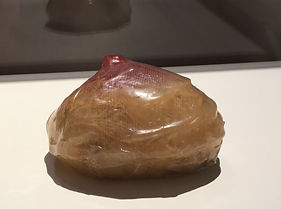
A Szapocznikow
Sans Titre/Without title (Love 1970)
Polyester resin, and gauz
Bullet point notes made in preparation for the Cross Pathway Group Crit.
My current research question for Unit 2:
What is the difference in the way societal/collective and personal trauma is expressed in contemporary artists work?
My key topic of investigation is
-
I am continuing with my Unit 1 investigation into trauma, both emotional and physical
-
I am looking at the effects of trauma on us and how it is expressed by contemporary artists
-
A key question for me is there a difference in expression between societal and personal trauma and can the two or are they always combined?
-
My work is concerned with the vulnerability of our (female) bodies and developing a visual language from how we look inside or respond to injury and disease tthat I can use to express trauma in my own practice.
-
I am also pursuing an investigation into materiality; to develop a more refined consciousness about the materials I select and use to make my work, as well as a deeper awareness of the materials symbolic and metaphorical meaning
-
Autobiography/women artist’s work, has become a key theme I am concerned with giving autobiographical work it’s correct status (autobiography is also a discussion of the world/what it is to be human, personal is political).
2 How do you aim to explore them through your
critical practice research?
-
Visiting and drawing medical collections - bones Museum of London, anatomical tables Royal College of Physicians, Wellcome Collection, Gordon Museum if I can get permission (Hunterian Museum/Royal College of Surgeons currently closed). Internet images of blood and cells.
-
Broaden my knowledge and understanding of the properties of potential materials to use in my practice primarily through experimentation but also by speaking to experts both inside and outside Camberwell ie dying with natural dyes, stitching, resins/making sculptural forms.
-
Embroidery techniques see samples in collections V&A, Historic Royal Palaces, Royal Collection, possibly speak to a curator/conservator? Speak to practitioners, Naomi Avesec/Paula Reason
-
Seeing the work of the artists I am researching, on display/reserve collections Belinde de Bruyckere on painting g with wax?
-
Possibly interviewing artist if there is one in particular stands out as speaking to my work.
3 What do you hope to discover?
-
What is/Is there a difference in the way societal/personal trauma is
expressed, if so what is it? The artists I have investigated closely this term Berlinde de Bruyckere (poverty, refugees), Alina Szapocnikow (Holocaust, cancer) are concerned with both…(Eva Hesse and
Louise Bourgeois)
-
To discover the materials to use to realise my work so that its appearance matches my concept and intention.
-
Artists who use ideas of the corporeal/the body in the abstract expression of trauma and whose work resonates with mine, concentrating on contemporary practice (not 1950s as I did in my January presentation).
-
The different ways trauma is processed in artists work – not art-therapy but psychological processing, unconsciously, how a narrative of trauma manifests itself.
-
How I can use the metaphorical and physical ‘skin’ of my work to express trauma. [Skin has become more and more important physical skin in work, the canvas and metaphorically). ‘…that the surface of the canvas acted as a skin of traumatic memory that was surely related to the recently ended war’ (Lorenza Trucchi quote from my last presentation)’ to G Pollock quoting the writer Charlotte Delbo, French resistance fighter and concentration camp survivor, in relation to sculptor Alina Szapocznikow’s work ‘ The skin enfolding the memory of Auschwitz is tough. Even so it gives ways at times revealing all it contains…Deep memory preserves sensations, physical imprints. It is the memory of the senses.’]
4 Which artists, writers and other cultural references contextualise and support your ideas?
-
Artists – Alina Szapocnikow, Belinde de Bruyckere, Loiuse Bourgeois, Eva Hesse, Doris Salcedo, (Doris Salcedo, Helen Chadwick, Hanaa Malallah)
-
Books - Griselda Pollock ‘After-affects | After-images: trauma and aesthetic transformation in the virtual feminist museum’. Gudrun and Harris ‘The Image and the Witness’
5 How do you plan to structure your writing (or presentation)?
-
As an essay or presentation…Provisional title ‘An exploration of trauma and it’s expression through the female body’ Autobiography?
-
Structure, state question and key areas of exploration / what I discovered and put case for my assertion that …. (yet to be formulated) … map research and how it supports what I am say (specifically use primary research where I can), conclude with quote/film clip/… something exciting!
6 How does this relate to your on-going studio practice?
-
Experimenting with dying chemical and natural, contact Wimbledon/Chelsea to do large quantities
-
Experiment with acrylics to soak-stain fabrics/canvas a la Helen Frankenthaler advice from Tim Johnson and AP Fitzpatrick, Bethnal Green.
-
Making sculptural parts for work, stitching/stuffing/wiring calling on my own expertise and that of experts Wimbledon/Chelsea, other externals?
-
Make sculptural forms in Camberwell workshops, cast wax/resin/plaster etc?
-
Draw, describe (in words), make/make/make forms/work and by doing so investigate and interrogate exactly how I want the work to appear - the weight/look and feel.
-
Investigating scale, human size/environments and how this affects audience response to the work.
-
Test audience response - through exhibiting - resonates with my intention.
-
Through doing all this equip myself with the skills required to realise resolved pieces in Unit 3 and make them match my intention.