The Transformation of Silence into Language and Action*:
how do encounters with contemporary art shape the personal narratives we
require to navigate trauma and illness?
MA Fine Art Painting: Critical Practice Essay
29 August 2020
___________________________________________________________________________________________________________________________________________________________________
* with thanks to Audre Lorde
Helen Chadwick, Enfleshings I and II, 1989
106 x 915 x 18 cm each image
Transparency on lightbox
(Ingham, 2020)

Abstract
This essay is an investigation into the transformative power of encounters with contemporary art on the construction of personal life narratives. Through the work of Arthur W Frank it will establish how our stories, once deemed ‘medically irrelevant’, are now part of recognised clinical practice and accepted as essential to our ability to navigate the experience of life threatening illness. Focussing on specific examples of the work of Helen Chadwick, Jo Spence, Hannah Wilke and Jesse Darling and the writing of author Audre Lorde, it will analyse the difference between ideas engendered through direct representation in art and those induced through sensation. Each section is prefaced with the author’s personal testimony and titled using key concepts contained in the artists’ work of flesh and the body, courage, empathy and vulnerability. The titles link the artists to experiences of illness contained in contemporary writing and the author’s personal testimony which is used as an example of a personal narrative in development. Setting these ideas in the context of the Coronavirus pandemic it will discuss the meaning of vulnerability and precarity through contemporary philosophy and examines what it is to be vulnerable. Drawing parallels between the concepts of vulnerability, uncertainty and ‘not knowing’, it will propose the question: what are the implications of continuing in a state of vulnerability for the author and art practices in general?
Key Words
___________________________________________________________________
personal narrative | vulnerability
illness | contemporary art | narrative medicine
________________________________________________
I have seen 8.7 million, of my own stem cells floating in a reddish yellow liquid extracted by the extraordinary science of apheresis. I know they successfully lived outside of my body 2.4 kilometres away, deep frozen and secure in plastic pouches in a place unseen by me and where some still remain. One month after separation half were slowly, with ceremony but no fanfare, brought up to 37 degrees Celsius and in four separate infusions were reunited with my flesh. Precisely timed by two technicians each infusion deemed to take no longer than 20 minutes from start to finish, and so guaranteed not to exceed their use-by date. Fourteen days later, by soaring neutrophils of 2.52, they were determined to be engrafted.
This essay will investigate the creation of personal narratives in response to encounters with contemporary art. An examination of the work of Arthur W Frank, Professor of Sociology, University of Calgary and the words of Anne-Marie Creamer artist and lecturer at Central Saint Martins will establish the importance of storytelling to our ability to understand and make sense of the experience of life threatening illness. Each section of the essay is prefaced with the author’s own testimony which connects the construction of personal narrative to encounters with specific works by Helen Chadwick, Jo Spence, Hannah Wilke and Jesse Darling. Interwoven throughout are extracts from the works of Audre Lorde, Sinéad Gleeson and Anne Boyer which map the creation of their stories arising out of their experiences of cancer and chronic illness.
The location of the work of Jo Spence and Audre Lorde in the context of 1980s feminism reveals the relationship of their work to the politics of the time and how they used honest testimony and direct representation of their experiences as a political tool. The introduction of Jill Bennett’s theory of ‘empathic vision’ is used to contrast direct representation of personal experience in art with works that harness sensation as a way to induce ‘critical inquiry’. These ideas are further examined through the work of Helen Chadwick and Jesse Darling, prompting consideration of their work in relation to that of American philosopher Judith Butler and author Johanna Hedva on vulnerability and precarity. Setting their ideas in the context of the global pandemic raises questions about what it means to be vulnerable, the consequences of Coronavirus and the implications of this for the author’s own practice.
Flesh
_____________________________
The body is an afterthought. … Unless it’s involved in pleasure or pain, we pay this moving mass of vessel, blood and bone no mind. The lungs inflate, muscles contract, and there is no reason to assume they won’t keep on doing so. Until one day, something changes: a corporeal blip.
(Gleeson, 2019 p.1)
_____________________________
The most important psychological tool we possess to make sense of our lives and maintain mental well-being is storytelling. It gives us our self/identity and the sense of a meaningful life, enabling us to use the present to link to our past and project into our future (Crossley, 2000). But when diagnosed with a life-threatening illness our life narrative collapses until we are able to make sense of what is happening through the new stories we develop. We become cognizant of vulnerability in our bodies and in the world, as Anne-Marie Creamer describes it, illness is ‘not just a change in bodily function it actually shapes the entire way you can be in the world.’ (Creamer, 2019, 09:30)
When we fall ill in the First World, we become submerged in technical expertise as diagnostic tools, symptoms and treatment regimes are described using indecipherable specialist language. This is the official story of our illness, but other stories proliferate as we tell family and friends versions of what we understand the doctor to have said (Frank, 2013). Our illness becomes a
circulation of stories, professional and lay, but not all stories are equal. The story of illness that trumps all others is the medical narrative. The story told by the physician becomes the one against which others are ultimately judged true or false, useful or not. (Frank, 2013 p.5)
The pioneering work of Sociologist Arthur W Frank is largely responsible for changing the way we think about storytelling and healthcare by recognising the importance of what had previously been seen as medically irrelevant: our human need to create narratives that make sense and meaning of illness. In the last ten years this work has led to the foundation of the discipline of ‘narrative medicine’, a medical approach that utilises people's narratives in clinical practice, research, and education as a way to promote healing.
Art and literature are powerful tools in the construction of these narratives; by providing a vehicle for the exploration of ideas they lead us to a deeper consideration of our experiences. Through them we are able to confront what might be deemed too difficult in any other sphere such as what lies beneath our skin.
The reddish yellow brown colour of my stem cells is very particular, it is the colour of butchered flesh and meat, the colour of Helen Chadwick’s Enfleshings I and II. The two photographs hover on lightboxes, their magnified detail spread obscenely by the imagined hand of the artist, a woman who admirably pays no heed to a culturally determined female squeamishness. The glistening muscle, fatty rips and crevasses are laid out to be examined in unashamed and perverse detail lingering somewhere between fascination and abhorrence. The ‘light trail’ superimposed just below the centre of Enfleshings I emphasises the vulvic, a symbol of sexual pleasure?
Though she does not appear in these images Chadwick’s presence is sensed in the precise execution of the photographs and method of display. The body, its relationship to nature and the cycle of life and death, are all recurring themes in Chadwick’s work. These images confront us with our biology. The Oval Court, 1986, is composed of images of Chadwick’s nude body alongside a myriad of objects including the carcasses of animals and fish. It too leads to considerations of sexual pleasure and frivolous transient enjoyment, of what it is to be mortal and susceptible in a vulnerable world. Of it Chadwick said
I want to catch the physical sensations passing across the body – sensations of gasping, yearning, breathing, fullness. The bodies are bearing their sexuality … Each of them is completely swollen up with pleasure at the moment when it’s about to turn, each has reached the pitch of plenitude before it starts to decay, (Chadwick 1989, p.39)
Courage
_____________________________
When it came right down to deciding, … I felt inside myself for what I really felt and wanted, that was to live and to love and to do my work, as hard as I could. So I simply chose the course most likely to achieve my desire, knowing I would have paid more than even my beloved breast out of my body to preserve that self (Lorde, 1980 p.32)
_____________________________
The courage to look. I have always been squeamish, donating blood makes me faint but my haemoglobin levels have dropped, something routinely addressed by a blood transfusion. There is a time delay between the doctor ordering the blood and its arrival. After eight days in hospital I know I’m dependant, I need the attention of the nurses, nursing assistants, cleaners and catering staff and have never been so grateful for the care they offer. So unhesitating I make clear how nervous I feel about the ‘routine’ transfusion. I tell the nurse on shift and the ward manager, then the next nurse on shift … The blood arrives too late, it takes several hours to run and it’s my first, they won’t run it overnight. Blood to the fridge and I to sleep. 6am ‘obs’ taken QR code on the blood bag read and matched to my wristband. Blood bag carefully positioned on the IV stand out of view, linked by a plastic tube to my PICC line, a sheet to cover my arm so I can’t see the blood entering me. ‘Would you like tea?’ how are these small acts of kindness remembered in amongst everything else? Returning every twenty minutes for the first hour as protocol dictates, the nurse asks, ‘Are you OK?’ I am and more; in her absence I have tested my courage, turned to face the blood full-on and taken several photos, as proof. This is as Lorde says, ‘work I must do alone’, and so I do.
During second wave feminism Audre Lorde and Jo Spence made public their experiences, their personal stories, of diagnosis and treatment for breast cancer through their art and writing. Jo Spence created a photographic series A Picture of Health? between 1982 and 1986 and Audre Lorde wrote frankly about the realities of her illness in The Cancer Journals published in 1980. A key tenet of 1980s feminist politics was the right of women to know, understand better and take control of all aspects of their bodies, from freedom from sexual violence to knowing and understanding themselves sexually; as illustrated by publications such as Our Bodies Ourselves, 1978 and For Ourselves, 1981. The work of both Spence and Lorde is a reflection of this, both saw their work as a political act aimed at maintaining their self-identity and demystifying breast cancer treatment for other women. They also sought to challenge the treatment women received at the hands of a predominantly male medical profession.
Acutely aware of her identity ‘my consciousness as a woman, a black lesbian feminist mother lover poet all I am’ (Lorde, 1980 p, 25), Lorde writes honestly about her struggle to remain true to her self-identity, as she navigates illness and treatment and confronts with stark honesty the frightening prospect of her own mortality.
In becoming forcibly and essentially aware of my mortality, and of what I wished and wanted for my life, however short it might be, priorities and omissions became strongly etched in a merciless light, and what I most regretted were my silences. Of what had I ever been afraid? To question or to speak as I believed could have meant pain, or death. But we all hurt in so many ways all the time, and pain will either change, or end. Death on the other hand is the final silence. (Lorde, 1980 p. 20)
Spence, conscious of herself as a working class woman, used photography to confront and document her hospitalisation and illness. As well as challenging medical orthodoxy and advocating for alternative forms of healthcare she was interested in exploring the therapeutic potential of photography through 'photo therapy’, in which the subject was empowered to control their image to discover and represent unexpressed or repressed feelings and ideas.
The work of Spence and Lorde continues to command respect and has become the touchstone for many contemporary artists and writers, as witnessed by Oreet Ashery’s diary entry:
I have just come across the work of Jo Spence and her notion of ‘reinventing myself’ and I’m not sure of this as an idea. …Her work makes me think of illness and recovery as binary. I prefer the idea that there are different parts of me and in different times some parts become more dominant. (Misbehaving Bodies: Jo Spence and Oreet Ashery, 2019)
Author Johanna Hedva sees Lorde as the ‘godmother’ of her philosophy Sick Woman Theory, 2015 and it is to Lorde’s experience of breast cancer care that Anne Boyer turns for comparisons when writing The Undying, 2019, a book that documents the creation of her own narrative through art, literature and her experience of treatment for triple-negative breast cancer.
Empathy
_____________________________
The sick body has its own narrative impulse. … So we tell its story. Or try to. Not with an everyday voice, no, that doesn’t suffice. To escape illness or physical trauma, some turn to other forms of expression.
(Gleeson, 2019 p.175)
_____________________________
Surrounded by empathy. The Coronavirus has changed things: mask, hand-gel, temperature check, hand washing, more hand-gel. The treatment chairs - once open so we could chat and compare experiences, make friends and acknowledge our monthly meet-ups here - are now separated by curtains divided off into cubicles as if to emphasise our vulnerability and the threat we pose to each other. ‘Obs’ taken, cannula kit unpacked, absorbent paper napkin laid beneath my left arm, rested on a pillow. Tourniquet in place ‘sharp scratch’, the needle slides in, large syringe screwed into one of the two dangling connectors, then the seeping cold of the ‘flush’ as it enters my body. IV pump set to run for 15 minutes. I think of ‘Intra-Venus’ and feel glad Wilke had the courage to make them.
There is no question of the power of the personal testimony conveyed through the work of Jo Spence and Audre Lorde. In the early 1990s American artist Hannah Wilke, already with an established practice concerned with challenging the position of women in society, chose to make Intra-Venus a series of self-portraits that are testimony to her experience of the effects of chemotherapy on her body between December 1991 and August 1992. She died of lymphoma on 28 January 1993.
These photographs speak of forbidden subjects. They show a woman’s inflamed vagina, a mouth swollen and raw with sores, a partially bandaged torso its left breast clamped down with IV equipment, … They show a bald naked woman getting off a commode; her body sagging forward, she is barely able to stand up’ (Tierney, 1996)
When viewed online these images are intense, viewing them full size in a gallery would be even more so; the actual photographs are full colour and nearly two meters by just over one meter. The images are akin to a contemporary Instagram feed, the viewer feels like a voyeur. But Wilke invited us to look, she conceived of the project and wanted the photographs to be displayed.
The trauma depicted in Intra-Venus contains some of the innate problems associated with trying to convey trauma through contemporary art, difficulties described by Jill Bennett in Empathic Vision, 2005. Bennett states that trauma by its very definition is beyond language and representation, beyond description and to try to represent such extreme personal experience means ‘it is always vulnerable to appropriation, to reduction, and to mimicry.’
She asserts that such extreme experience remains ‘owned’ and ‘un-shareable’ even once communicated. Even those who have been through a similar event cannot ‘share’ another’s experience of trauma. (Bennett, 2005 p. 6) Wilke’s images elicit sympathy but is it possible to move beyond this understanding of them?
Bennett argues that trauma art can be more than a depository for interpersonal experience. It can operate at a deeper level, similar to what French philosopher Gilles Deleuze (quoted in Bennett, 2005 p.7) terms an ‘encountered sign’, a sign that is felt or sensed rather than recognised through cognition; a sign or sensation that is not an end in itself but is a catalyst for deep thought or ‘critical inquiry’. This is what Bennett terms ‘empathic vision’, art works that do not of and in themselves convey the ‘meaning’ of trauma but lead us towards a conceptual engagement with it. This she describes as ‘affective’, not born of emotional identification or sympathy but instead a result of direct engagement with sensation as it is registered in the work. Citing the work of Doris Salcedo as an example of this Bennett describes the way she constructs spaces in which loss is evoked rather than directly representing the injuries inflicted on victims by political violence.
'less an exploration of the impact of violence on individuals than a more expansive and political description of a world shaped by violence’ (Bennett, 2005 p.13).
Bennett’s ideas connect to a phenomenological reading of art, where engaging the senses in ‘seeing’ is paramount; sensation comes first, the cognitive interpretation of what is being understood through our senses comes second. This is apparent in the work of Helen Chadwick and the ideas of the vulnerability and the transience of life her work engenders but it can also be understood in the practice of Jesse Darling, though they use a very different aesthetic.
Vulnerability
_____________________________
Discomfort in need of diagnosis forms a feeling-scape of curious pains and corporeal eruptions, all untamed by the category ‘disease’. The kind of illness that has no name is the kind that is held in suspense or held in common or shuffled into the adjacency of psychiatry. (Boyer, 2019 p.17)
______________________________
I kept a journal, something later recommended by the hospital psychologist as a support tool. But I was already there noting with scorching honesty my thoughts and feelings, secure in the knowledge that the words were for my eyes only. Approaching the transplant I see in high definition my vulnerability and fear etched in its pages; notes of conversations with counsellors, my anxious requests to have the details of my treatment plan repeated over and over. But it is mostly in the colour pencil drawings that my desperate attempts to imagine a life post treatment comes through. I look on with detachment, I have already reconfigured her story. The fear is inaccessible, it will rise again next time to be inscribed in similar words and sketches in another journal …
As Creamer vividly describes, illness ‘shapes the entire way you can be in the world’ (Creamer, 2019, 09.30). It makes us aware of our own vulnerabilities and aware of the vulnerabilities of others. We realise we are dependant and this leads to a consideration of what care is and what care we can expect. In the First World with advances in medical treatments many of us are living with chronic conditions. Many cancer patients belong to what Frank calls the ‘remission society’; they are effectively well but can never be considered cured and many others live with conditions that are invisible ,from mental health illness to diabetes. Lives are no longer strictly divided between what Sontag terms the ‘kingdoms’ of the well and the sick; instead our ‘dual citizenship’ seems to mean exactly that, we have citizenship status in both kingdoms simultaneously and can oscillate between them.
Everyone who is born holds dual citizenship, in the kingdom of the well and in the kingdom of the sick. Although we all prefer to use the good passport, sooner or later each of us is obliged, at least for a spell, to identify ourselves as citizens of that other place. (Sontag,1978 p.3)
The Coronavirus pandemic has focused global debate on to issues of care and vulnerability. In her recent work on vulnerability and resistance Judith Butler (2015) equates the idea of vulnerability with precarity. She describes it as a state where we are not just at risk of harm being done to us but at risk of being harmed by social inequalities such as poverty and systemic racism. Discussing the pandemic in her recent online lecture for the Whitechapel Gallery she described how Coronavirus has exposed global vulnerability as no-one is immune to viral infection. It has not only highlighted societal inequalities but has perhaps most significantly revealed that
‘all our bodies are irreversibly implicated in one another’s and life itself depends upon an organisation of that interdependency’ (Butler, 2020, 29:00)
Author Johanna Hedva has also linked vulnerability and disenfranchisement with precarity in her essay ‘Sick Woman Theory’, identifying the 'Sick Woman' as
an identity and body that can belong to anyone denied the privileged existence – or the cruelly optimistic promise of such an existence – of the white, straight, healthy, neurotypical, upper and middle-class, cis- and able-bodied man who makes his home in a wealthy country, … at the expense of everyone else. (Hedva, 2016)
Hedva and Butler redefine existence in a body as something that is primarily and always vulnerable. These themes are explored through the installations of Jesse Darling, works that induce sensations directing us to a deeper consideration of these concepts.
Their work does not describe through bloodied damaged forms the injured body, instead it is in the perfection of their materiality that they beg questions about dependence and vulnerability. The steel and aluminium so familiar from mobility aids is immediately recognisable, though their finish is more perfect, less ‘life worn’ than any mobility aid we are familiar with in hospital or on the street. The flawless finish speaks of beauty and the intact, perfect mobile body; like airbrushed models in a magazine their perfection is amplified by their display in a ‘White Cube’ gallery space. But the forms they manifest suggest something else; they are impossible to use for support. Looking at them the viewer feels their futility and imagines their own body sliding across the floor grasping for the cane’s support. In these modified instruments of the ‘care industry’ Darling prompts us to consider not only the vulnerability of our bodies but wider themes of the precariousness of all things, something they term ‘precarious optimism’, a state where living beings, societies and technologies are fundamentally fallible and fungible. Their work is poignant and deliberately so. Interviewed about the exhibition Support Level Darling states
‘making public my own vulnerabilities and inconsistencies was a decision…something I felt I could defend politically’ (Chapter NY, 2018).
We are all susceptible to affliction, the bodily doubt that illness invokes in us may put our personal vulnerability and dependency centre stage but to imagine we are self-sufficient in the world is a delusion. Hedva proposes that if we were all publicly able like Darling to acknowledge our vulnerabilities and inconsistencies, this would be a better place to be. Creamer too sees the potential of this. She describes the experience of vulnerability as a place of uncertainty but also a dynamic space
Vulnerability is the crucible of learning and creativity because you cannot learn, negotiate thresholds of new experience and self without being in the vulnerability of not knowing (Creamer, 2019, 27:04)
Knowledge
_____________________________
illness is a form of knowledge with existential impact, illness modifies and sheds light on normal experience revealing ordinary overlooked structures
(Creamer, 2019,11:05)
_____________________________
Sirsasana; the joy of inversion. The knowledge held in my body. Elbows positioned, head down, skull cupped in lightly clasped hands, a gentle skip to hover the knees off the ground, then steadied the legs stretch up to the ceiling. Breathe and relax your face, it is not what is supporting you.
The experience of illness is profound, it changes our world view and the way we can be in the world. My research began with an inquiry into why certain artworks had become important to me at a time of acute trauma. It has led to something completely unexpected: a deeper understanding of how contemporary art operates on the senses and engages us with concepts that can have a transformative power on our thinking and personal narratives. Through the period of my MA studies I have acquired more sophisticated tools for interpreting contemporary art that have enabled me to reassess the direct testimonies of Spence, Wilke and Lorde and why they have held importance for me. But as my ideas have changed I have begun to recognise that engaging with the concepts embedded in the work of Chadwick and Darling offers perhaps a more fruitful line of enquiry. The change in my practice reflects this as over the course of the MA my work has shifted from being representational paintings to abstract three dimensional forms.
None of this has happened in a vacuum. The experience of the pandemic and the directive to ‘shield’ led to an intense awareness of my own vulnerability and made the themes of my practice a global debate around trauma, inequality, vulnerability and care, one that will continue for the foreseeable future. Ironically the necessity for physical isolation created the perfect conditions for deep reflection on my research and experimentation within my practice. Being in my own space where I could be vulnerable and in a state of ‘not knowing’ is a place helpful to any art practice, a space in the words of Sol LeWitt to ‘just do’ (Letters Live, 2016, 01:27).
All our stories are constantly being reworked and updated in response to new encounters. My studies over the past year have led me to appreciate that being vulnerable can also be a place of possibility.
Post script: My essay links to exhibitions link and link I have visited and research link I have been engaged with throughout the year of MA study, here are links to a few examples.
References
_____________________________________________________________________
Bennett, J. (2005) Empathic Vision: Affect, Trauma, and Contemporary Art. Stanford. Stanford University Press
Boyer, A. (2019) The Undying: A Meditation on Modern Illness. London. Penguin Books
Butler, J. (2020) The Force of Non-Violence online lecture Whitechapel Gallery, London
23 July 2020 Available at: https://www.whitechapelgallery.org/events/judith-butler/ (Accessed: 15 August 2020)
Chadwick, H. (1989) Enfleshings. London. Martin Secker and Warburg Limited
Chapter NY. (2018) Support Level Jesse Darling. Available at: http://chapter-ny.com/exhibitions/past/jesse-darling/(Accessed: 5 August 2020)
Creamer, A-M. (2019) The Wounded Storyteller: on speaking vulnerability, acknowledging dependence. Symposium on Vulnerability and Resistance Central Saint Martins, UAL, London 26 June 2019 Available at: https://www.arts.ac.uk/research/groups-networks-and-collaborations/creative-practices-education-and-wellbeing-research-network/on-vulnerability-and-resistance-symposium (Accessed: 9 June 2020)
Crossley, M. L. (2000) Narrative psychology, trauma and the study of self/identity Theory & Psychology. Available from: https://journals.sagepub.com/doi/abs/10.1177/0959354300104005
(Accessed 31 October 2019)
Frank, A W. (2013) The Wounded Storyteller: Body, Illness and Ethics. London. University of Chicago Press
Gleeson, S. (2019) Constellations Reflections from Life. London. Picador
Hedva J. (2016) Sick Woman Theory Mask Magazine. Available at: http://johannahedva.com/SickWomanTheory_Hedva_2020.pdf (Accessed: 6 June 2020)
Letters Live Sol LeWitt to Eva Hesse. Read by Benedict Cumberbatch. Available at: https://www.youtube.com/watch?v=VnSMIgsPj5M (Accessed: 26 August 2020)
Lorde, A. (1980) The Cancer Journals. New York. Spinsters Ink
Misbehaving Bodies: Jo Spence and Oreet Ashery (2019) [Exhibition]. Wellcome Collection, London. 30 May 2019 – 26 January 2020.
Sontag, S. (2002) Illness as Metaphor and Aids and its Metaphors. London: Penguin
Tierney, H. (1996). Hannah Wilke: The Intra-Venus Photographs. Performing Arts Journal, Vol 18 No. 1 (Jan.,1996). pp. 44-49. Available at: www.jstor.org/stable/3245813 (Accessed: 14 August 2020)
Images
_____________________________________________________________________
1. Helen Chadwick, Enfleshings I and II, 1989
106 x 915 x 18 cm Transparency on lightbox (Ingham, 2020)
2. Helen Chadwick, Enfleshings I, 1989
106 x 915 x 18 cm Transparency on lightbox (Ingham, 2020)
3. Blood transfusion I (Ingham, 2019)
4. Blood transfusion II (Ingham, 2019)
5. Jo Spence Crisis Project / Property of Jo Spence, 1982
(Ingham 2019)
6. Jo Spence Crisis Project / A Picture of Health: How do I Begin, 1982-83 (Richard Saltoun Gallery,1982)
7. Intra-Venus Series No. 4, 26 July and 19 February 1992
183 x 123 cm each image (Feldman Gallery,1994)
8.Intra-Venus Series No.4, 26 July and 19 February1992 183 x 123 cm each image (Feldman Gallery,1994)
9. Cyclophosphamide infusion (Ingham, 2019)
10. PICC line, Instagram feed (Darling, 2015)
11. Jesse Darling, Collapsed Cane, 2017 Steel, aluminium, rubber and lacquer,
75 x 56 x 25cm (Chapter NY, 2018)
12.Jesse Darling, Comfort.Station, 2017 Steel, aluminium, rubber and lacquer,
78 x 140 x 85 cm (Chapter NY, 2018)
Bibliography
_____________________________________________________________________
For Bibliography see attached PDF of full essay

Helen Chadwick, Enfleshings I, 1989
106 x 915 x 18 cm each image
Transparency on lightbox
(Ingham, 2020)
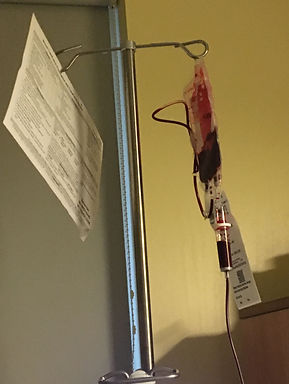
Blood transfusion I (Ingham, 2019)

Blood transfusion II (Ingham, 2019)

Jo Spence Crisis Project / Property of Jo Spence, 1982
(Ingham 2019)

Jo Spence A Picture of Health:
How do I Begin?,1982-83
(Richard Saltoun Gallery,1982)

Intra-Venus Series No. 4, 26 July and 19 February 1992
183 x 123 cm each image
(Feldman Gallery,1994)

Intra-Venus Series No. 4, 26 July and 19 February 1992
183 x 123 cm each image
(Feldman Gallery,1994)

Cyclophosphamide infusion
(Ingham, 2019)

PICC line, Instagram feed
(Darling, 2015)
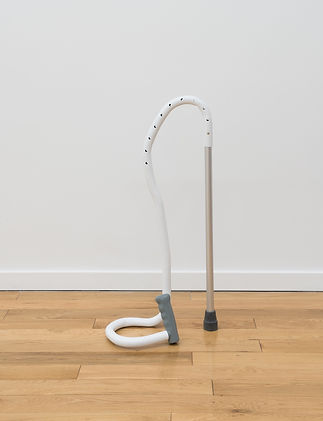
Jesse Darling, Collapsed Cane, 2017
Steel, aluminium, rubber and lacquer, 75 x 56 x 25 cm
(Chapter NY, 2018)
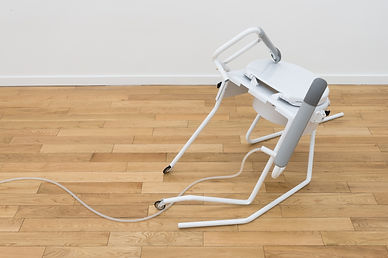
Jesse Darling, Comfort Station, 2017
Steel, aluminium, rubber and lacquer, 78 x 140 x 85 cm
(Chapter NY, 2018)